Disclosure: This article contains Amazon affiliate links. As an Amazon Associate, I earn from qualifying purchases.
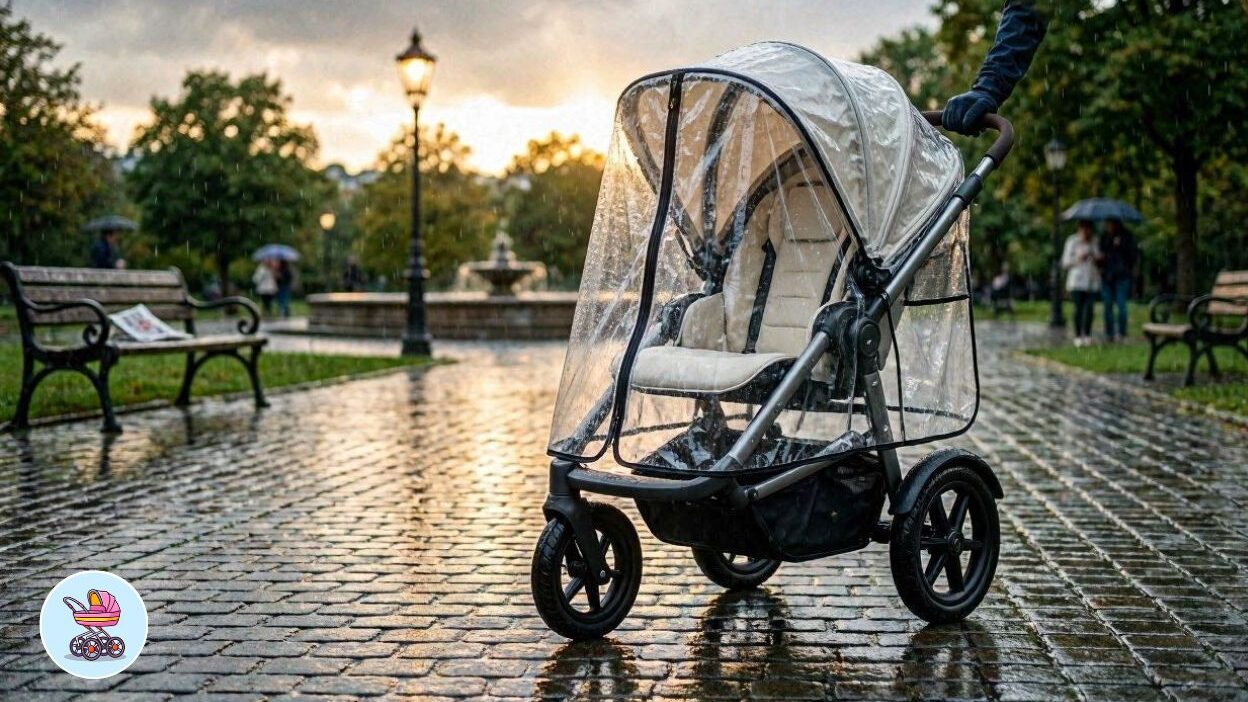
Weather doesn’t care about your schedule. School drop-offs happen in November drizzle. Park walks happen in April wind. Pediatrician appointments happen the one Tuesday it decides to pour.
For parents who don’t stop moving when the forecast gets bad — which is most parents — a stroller rain cover is one of those purchases you only regret not making sooner. It’s not complicated: a clear, lightweight shield that fits over your stroller and keeps your child dry while you keep going. No scrambling for blankets, no soaked baby, no rerouting your day.
This guide covers everything that actually matters — what to look for, which covers fit which strollers, how to put one on without a fight, when NOT to use one, and which brands hold up over time.
Table of Contents
1. What Makes a Stroller Rain Cover Worth Buying
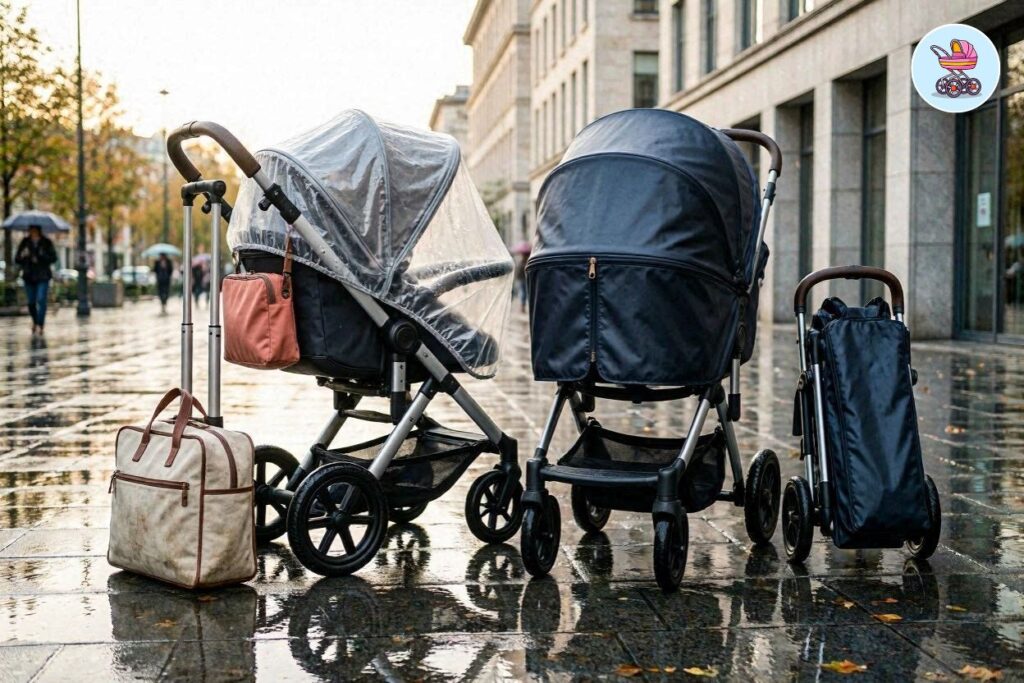
Not all rain covers are equal. A $9 cover that soaks through at the seams or fogs up solid within two minutes isn’t protecting your child — it’s just adding plastic to the situation. Here’s what separates a cover worth buying from one that ends up stuffed in a drawer.
Materials and Build Quality
The two plastics you want are EVA (ethylene-vinyl acetate) and TPU (thermoplastic polyurethane). Both are flexible, transparent, and free from the plasticizers found in older PVC designs. They stay soft in cold weather instead of cracking stiff, and they don’t yellow as fast under UV exposure. If a product listing just says “plastic” without specifying, that’s a reason to keep looking.
Reinforced seams matter. The seams are where water finds a way in during sustained rain or wind — look for covers that mention taped or double-stitched seams, especially around the canopy edge and footrest hem.
If you want a second opinion beyond the product listing, the American Academy of Pediatrics publishes general guidance on choosing baby gear materials that minimize exposure to harmful chemicals — worth a quick check if you’re buying for a newborn.
Ventilation
This isn’t optional. Ventilation openings — whether mesh side panels, covered vents, or perforated panels — are what allow fresh air to circulate so your child doesn’t overheat and so the window doesn’t fog solid. A cover without real ventilation is just a plastic bag. Check that the product specifically calls out its airflow design, not just the word “breathable.”
Weight and Portability
A good cover folds down to the size of a large sandwich. Most quality options weigh under 10 oz. If it doesn’t fit in your diaper bag’s outer pocket, it won’t be there when you need it.
Ease of Use
Velcro straps, elastic hems, and snap clips are the standard attachment methods. The test isn’t how it goes on at home — it’s how fast you can get it on while the rain starts, with a baby in the stroller and your hands cold. Any cover that takes more than 90 seconds once you’ve practiced it twice is too complicated.
Compatibility
Most covers designed for standard single strollers fit canopies between 15 and 19 inches wide. Outside that range — jogging strollers, double strollers, and some travel systems — you need to check dimensions carefully or buy a model-specific cover.
2. Universal vs. Model-Specific: Which One Should You Buy?
This is the first real decision you’ll make — and getting it wrong means either a cover that doesn’t fit or one you can’t reuse when you switch strollers.
Universal covers work across most standard single strollers. They attach with elastic hems or velcro straps, cost anywhere from $10 to $35, and are the practical choice if you own a mid-range or off-brand stroller, plan to hand the cover down, or use more than one stroller. The trade-off is fit: on unusual frames or very wide canopies, you’ll get small gaps at the edges where wind sneaks in.
Model-specific covers are designed to trace your stroller’s exact geometry — canopy shape, footrest angle, side panels. Brands like UPPAbaby, Bugaboo, and Graco sell covers built for their own strollers. You pay more (usually $40–$80), but the seal is tighter, the attachment is faster, and there’s no guesswork about whether it’ll fit. If you own a premium stroller and plan to keep it for two or three years, the model-specific cover is the better investment.
The one scenario where universal wins even for premium stroller owners: travel. A $15 universal cover in your carry-on bag beats leaving your $60 model-specific cover behind because you were worried about losing it.
| Universal | Model-Specific | |
| Price range | $10–$35 | $40–$80 |
| Fit quality | Good on standard frames | Precise on intended model |
| Portability | Compact, travel-friendly | Bulkier, heavier |
| Reusability | Works across strollers | Tied to one model |
| Installation speed | Slightly slower first time | Fast by design |
| Best for | Budget buyers, multi-stroller homes, travel | Premium stroller owners, windy climates |
Prices shift often on Amazon — treat the ranges above as ballpark figures and check the live listing before you buy.
3. Measure Before You Buy — 3 Minutes That Save a Return
Skip this and there’s a good chance the cover you order either won’t stretch over the canopy or will sit loose and flap in wind. Grab a tape measure and check three things:
Canopy width — measure the widest point of the canopy, fully extended. Most universal covers list a fit range (typically 15″–19″); if you’re outside that, you need XL or model-specific.
Canopy height — measure from the footrest to the top of the extended canopy. This matters more than parents expect, since tall canopies on jogging strollers or three-wheelers often push past what a standard cover can stretch to cover.
Footrest depth — measure how far the footrest extends from the seat. Covers with a short footrest hem will ride up and leave your child’s feet exposed in wind.
Do this measurement with the canopy both extended and folded back — some covers are cut for one position only, and a stroller that looks compatible folded back can come up short once the canopy’s up.
4. What Stroller Rain Covers Do Well — And Where They Fall Short
The case for buying one is strong. A decent cover blocks rain, wind, and road spray, keeps your child visible and dry, and folds down to almost nothing in your diaper bag. For the price — most quality options fall between $15 and $50 — it’s hard to find a stroller accessory that delivers more practical value per dollar.
That said, not every cover is worth buying. Budget models often skip reinforced seams, which fail in sustained wind or heavy downpours. Covers that lack proper ventilation fog up fast — and a fogged-up window means you can’t see your child, which defeats part of the purpose. And universal covers, while convenient, can gap at the edges on unusually shaped canopies or extra-wide double strollers.
The fix for most of these problems is paying slightly more and checking two things before buying: confirmed ventilation openings and a canopy size range that matches your stroller.
5. Are Stroller Rain Covers Actually Safe? Here’s What Parents Need to Know
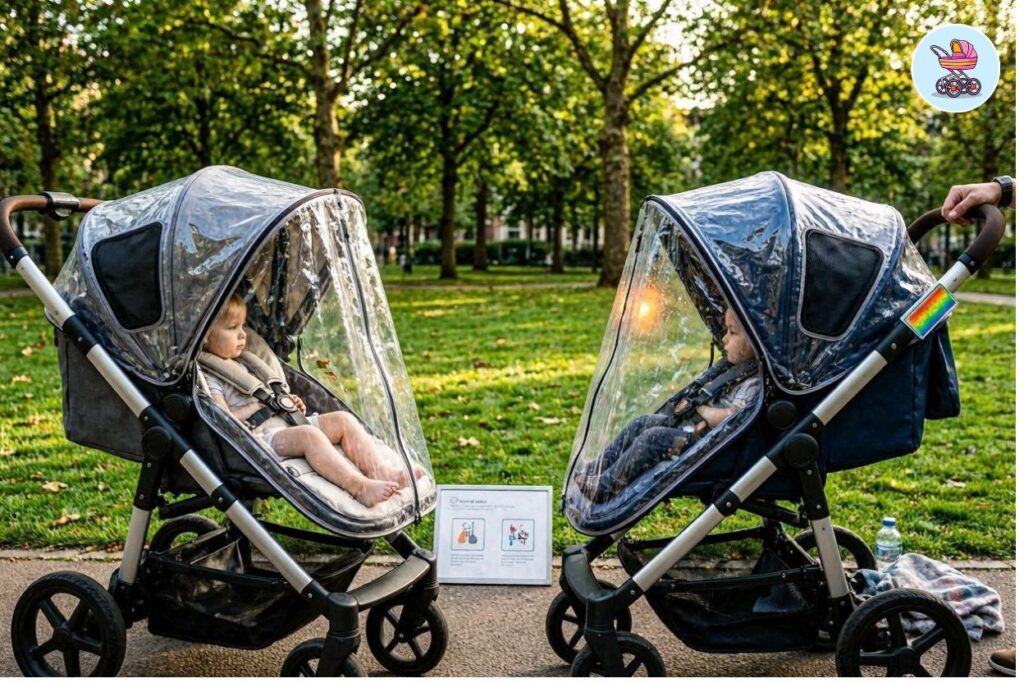
Short answer: yes — but only if you use them right. A rain cover is not a sealed bag. It’s a weather shield, and there’s a meaningful difference.
The risk most parents don’t think about is heat, not rain. On a mild but overcast day, temperatures inside a covered stroller can climb faster than expected — especially if you’ve also got a blanket tucked around the baby. That’s the same reasoning behind pediatric guidance on why babies shouldn’t be left in enclosed, poorly ventilated spaces for extended periods, even when it doesn’t feel hot outside.
Ventilation openings aren’t optional. They’re the feature that separates a safe cover from a dangerous one. Before you buy, confirm the cover has mesh panels or vented side openings — not just a single pinhole at the top.
Three things to check every single time you install the cover:
- All vents are open and nothing is blocking them from the inside — no tucked-in blanket, no bag pressing against the plastic
- The window is clear and flat — you can see your child’s face without distortion
- The bottom edge isn’t caught in the wheels or dragging on the ground
Material safety matters too. Covers made from EVA or TPU plastic are your best options. If a product listing doesn’t specify the material, that’s a reason to keep looking.
When NOT to Use a Rain Cover
This doesn’t get covered enough: a rain cover in warm, sunny weather is a hazard, not a convenience. Remove the cover immediately if the rain stops and the sun comes out. If it’s above 70°F and overcast, open every vent and check your child every few minutes. Above 75°F with direct sun? Take it off entirely, even in light drizzle.
A footmuff paired with a breathable rain cover is the right call for cold, wet weather. A rain cover alone in hot weather — even light rain — is the wrong call.
Quick Reference — When to Use (and Remove) Your Rain Cover
| Weather Condition | Recommended Action |
| Rain, under 65°F | Cover on, all vents open |
| Rain, 65–72°F | Cover on, check child every 10 min |
| Rain, above 72°F | Cover on max 15 min, watch for sweating |
| Sun + light drizzle, above 68°F | Remove cover, use canopy instead |
| Wind only, no rain | Cover optional — check child’s comfort |
| Snow or sleet | Cover on, pair with footmuff for warmth |
Remove the cover immediately if your child shows signs of sweating, flushed skin, or irritability. Always prioritize your child’s comfort over weather protection.
6. When a Rain Cover Earns Its Place in Your Bag
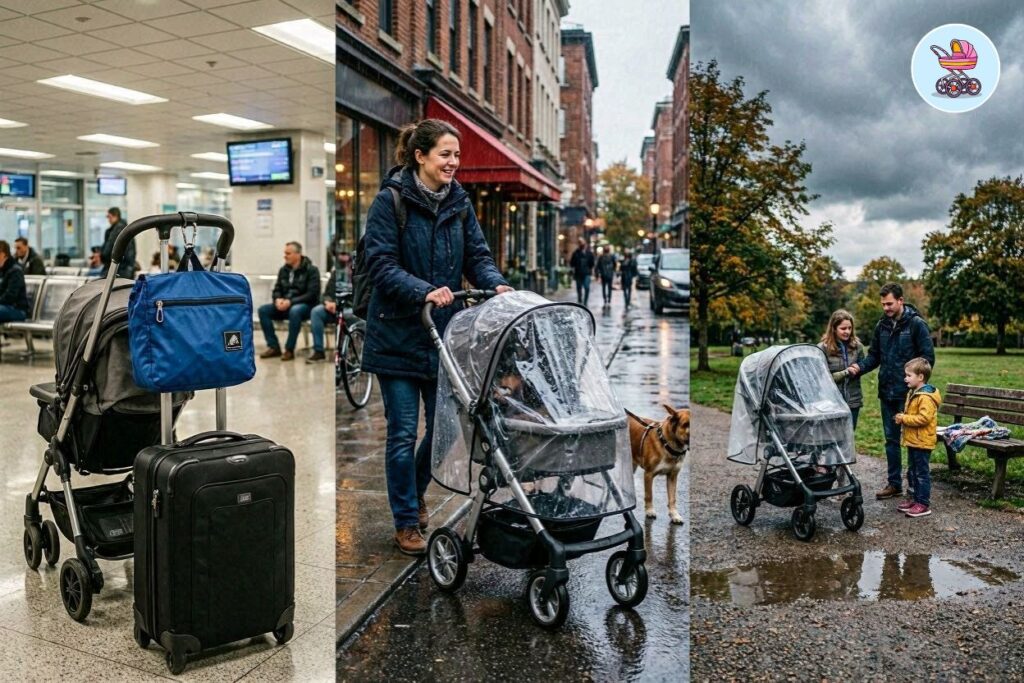
Travel
Airports, theme parks, sightseeing — anywhere you’re outdoors for hours at a stretch and can’t duck inside every time the weather shifts. A cover that folds into its own pouch is ideal here. Pack a universal one in your carry-on even if you own a model-specific cover at home.
City Errands and Daily Commute
Brief runs to daycare, the grocery store, appointments — this is where a rain cover pays off fastest. The ability to keep moving without stopping to reorganize the stroller or drape blankets over a screaming wet baby is worth every dollar.
Parks and Neighborhood Walks
Unpredictable afternoon showers are the main threat here. Keep the cover in the stroller’s under-basket so it’s there when you need it, not at home.
Double Strollers Need Their Own Rules
A single-stroller cover stretched over a side-by-side frame is how you end up with gaps at the seams and one kid getting rained on while the other stays dry. If you’re pushing two, don’t improvise — see our Best Double Stroller Rain Covers guide for covers actually sized for tandem and side-by-side frames.
And the reminder that bears repeating: hot weather, direct sunlight, or any time your child looks flushed or fussy under the cover means it comes off. It’s a tool for specific conditions, not something that lives on the stroller permanently.
7. How to Put a Rain Cover on a Stroller (Step-by-Step)
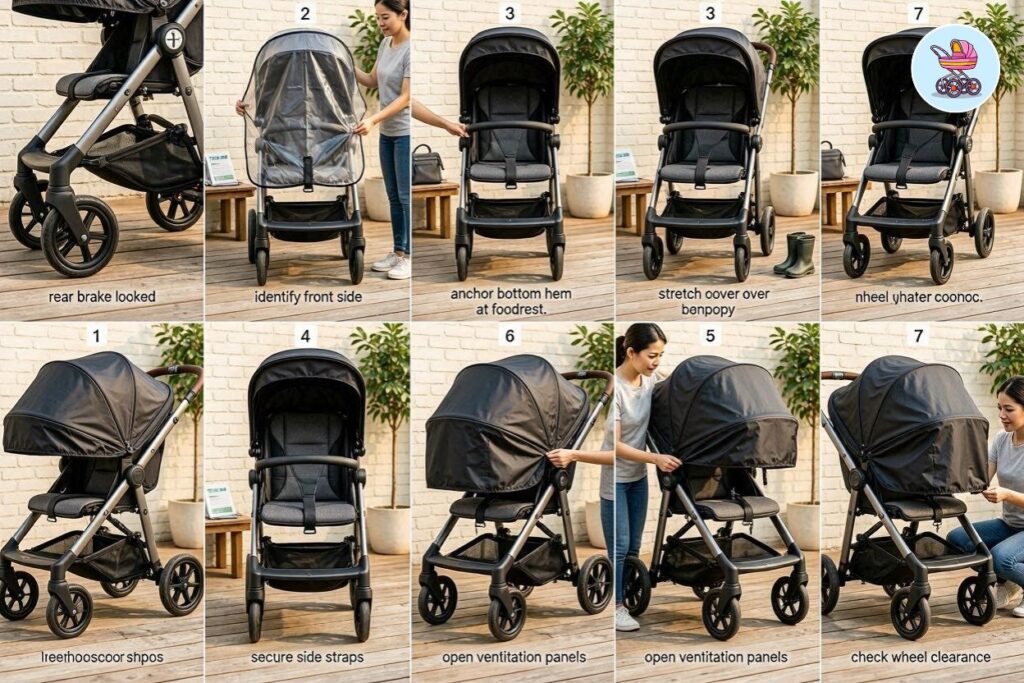
Most covers go on in under 60 seconds once you’ve done it once. The problem is the first time — in the rain, on a sidewalk, with a baby in the stroller. Practice at home. Here’s the standard method that works for most universal covers.
Step 1 — Set your brake. Lock the stroller before you do anything. A cover going on a moving stroller is a wrestling match you’ll lose.
Step 2 — Orient the cover correctly. Find the front — usually marked by a zipper, logo, or wider window panel. The clear viewing window faces out toward you, not toward the child.
Step 3 — Start at the footrest. Anchor the bottom hem first. Pull it snug under the footrest bar. This gives you a fixed point to work from and stops the cover from riding up later.
Step 4 — Stretch it up and over the canopy. Don’t force it. If it’s resisting, you likely have it back-to-front or it’s undersized for your canopy. A proper fit stretches smoothly without pulling.
Step 5 — Secure the sides. Work elastic edges, velcro straps, or snap clips down each side. The cover should lie flat — any pooling fabric will collect water and add weight.
Step 6 — Open every vent. Don’t skip this step. Open all ventilation panels before you move.
Step 7 — Check the bottom edge. It should clear the wheels by at least an inch on all sides and not drag on the ground.
The whole process takes about 45 seconds once it’s familiar. The single biggest mistake parents make is waiting until it’s raining to figure out their cover.
Common Problems (And Fast Fixes)
It keeps blowing off in wind: The lower hem isn’t secured properly. Reattach from the footrest up, making sure elastic hems are pulled all the way under the frame bar, not just resting on top of it.
It’s fogging badly: You have at least one vent blocked. Check the interior — a tucked-in blanket or bag pressing against the plastic is usually the culprit. If the cover has no vents at all, return it.
It won’t stretch over the canopy: The cover is likely undersized for your canopy width. Measure your canopy’s widest point and compare it to the cover’s stated fit range before buying a replacement.
8. Best-Selling Stroller Rain Covers on Amazon (USA)
Five consistently well-reviewed options available from major U.S. retailers — selected for ventilation design, fit range, and customer feedback.
1. Clear Stroller Rain Cover – Universal Travel Weather Shield for All-Season Baby Protection
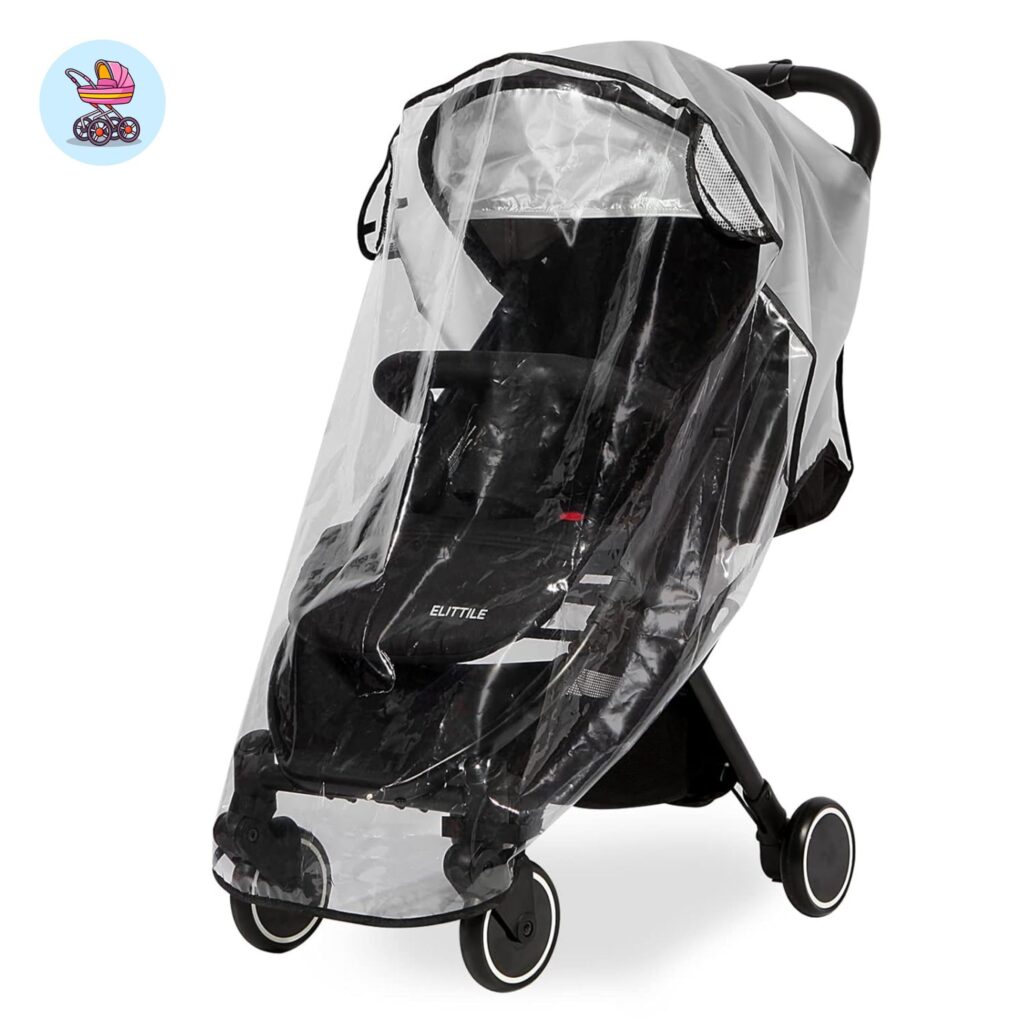
The go-to for parents who want reliable all-weather protection on daily walks and travel. Fully waterproof construction with a clear panel design that keeps babies visible from both sides.
Pros:
- Fully waterproof and windproof
- Clear design allows full visibility of the baby
- Breathable ventilation for airflow
- Lightweight and easy to fold
- Fits most standard single strollers
Cons:
- Plastic feels thin in sustained heavy storms
- Not insulated for very cold winter weather
2. Stroller Rain Cover – Universal Waterproof & Windproof Weather Shield for Baby Travel
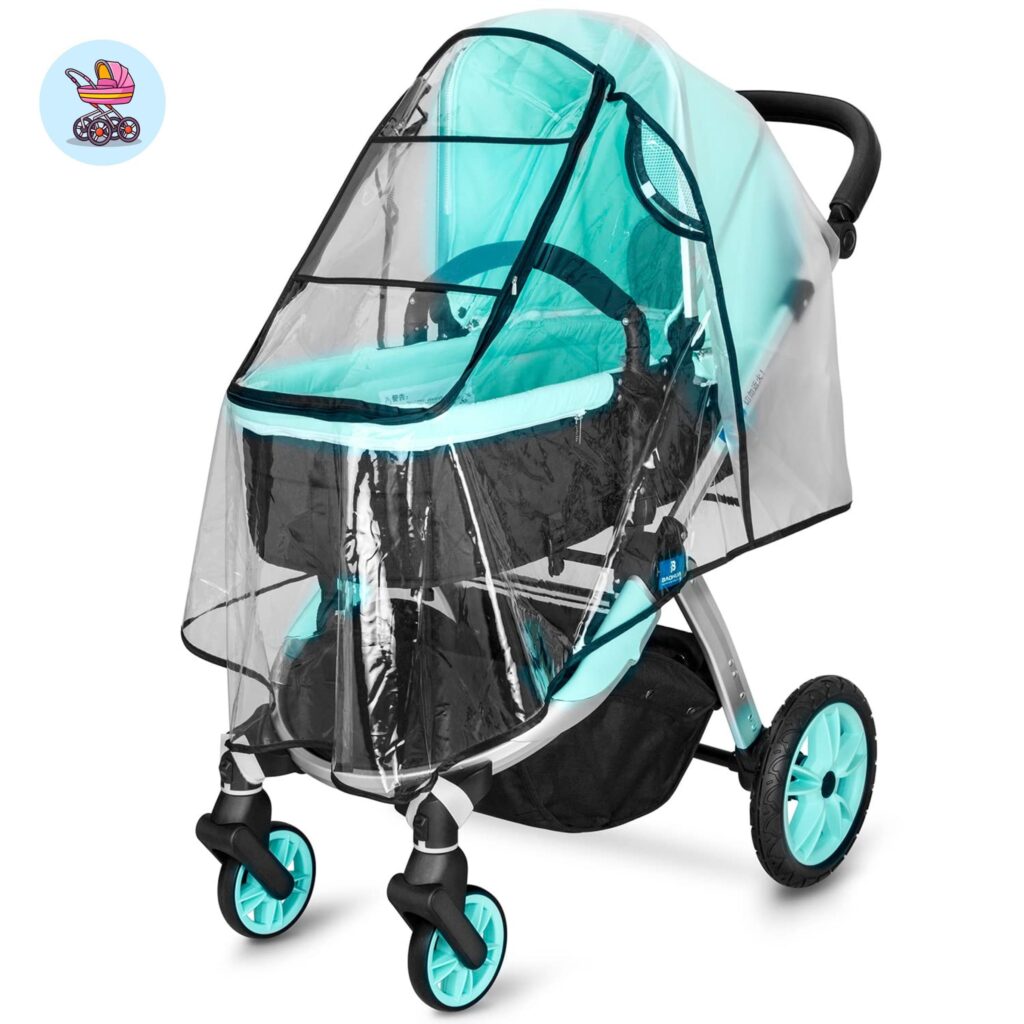
A solid everyday option for parents who want straightforward weather protection without paying for premium features. Quick on, quick off.
Pros:
- Universal fit for most standard strollers
- Waterproof and wind-resistant material
- Fast installation and removal
- Compact for travel and storage
- Affordable for daily use
Cons:
- Ventilation is more limited than premium models
- May need adjustment on larger stroller frames
3. Universal Stroller Rain Cover – Clear Breathable Waterproof Weather Shield (XL, 4 Seasons)
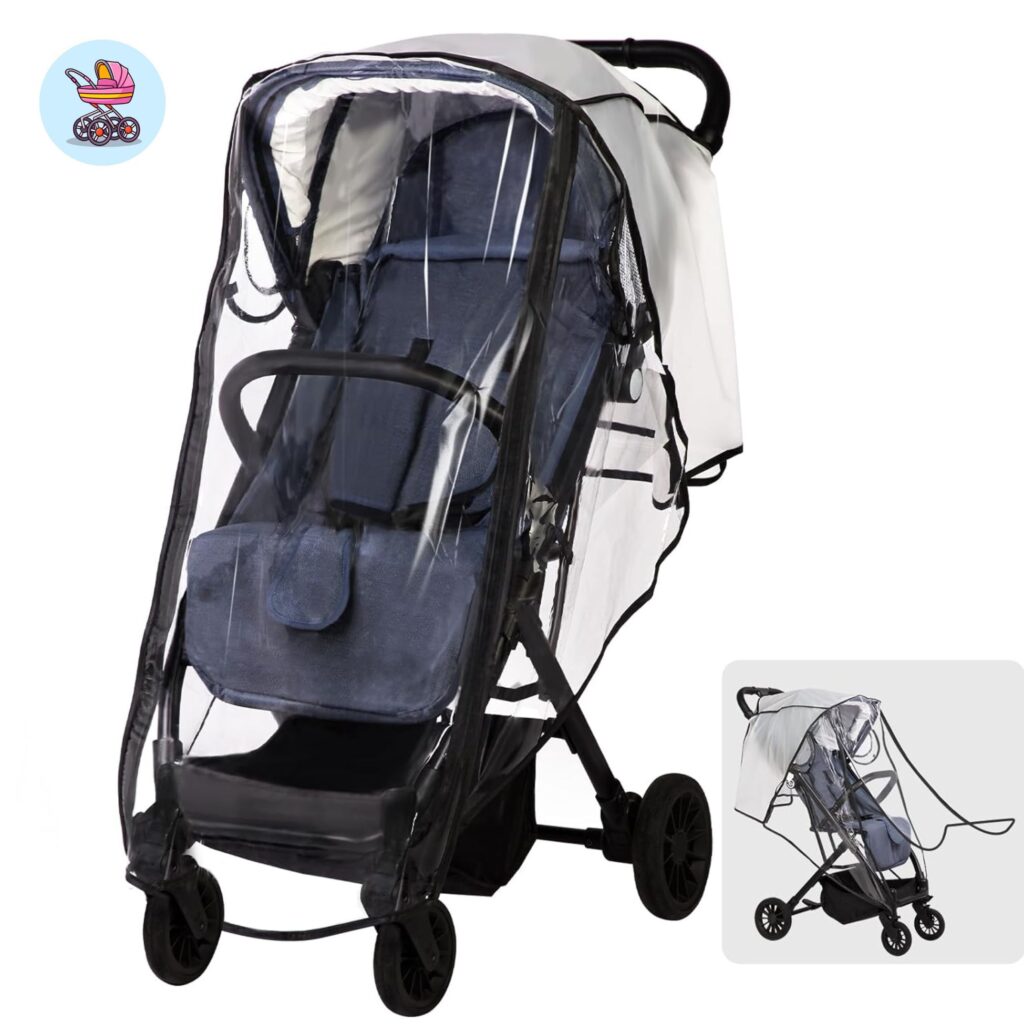
Built for jogging strollers and XL frames where standard covers fall short. The waterproof zipper is the standout feature — useful when you need to reach your child without removing the whole cover.
Pros:
- XL size fits larger and jogging strollers
- Waterproof zipper for easy baby access
- Breathable airflow design
- Suitable for all four seasons
- Durable, tear-resistant material
Cons:
- Slightly bulkier when folded than standard covers
- Higher price than basic universal covers
4. Graco Travel System Weather Shield – Universal Baby Stroller Rain Cover for All-Weather Protection
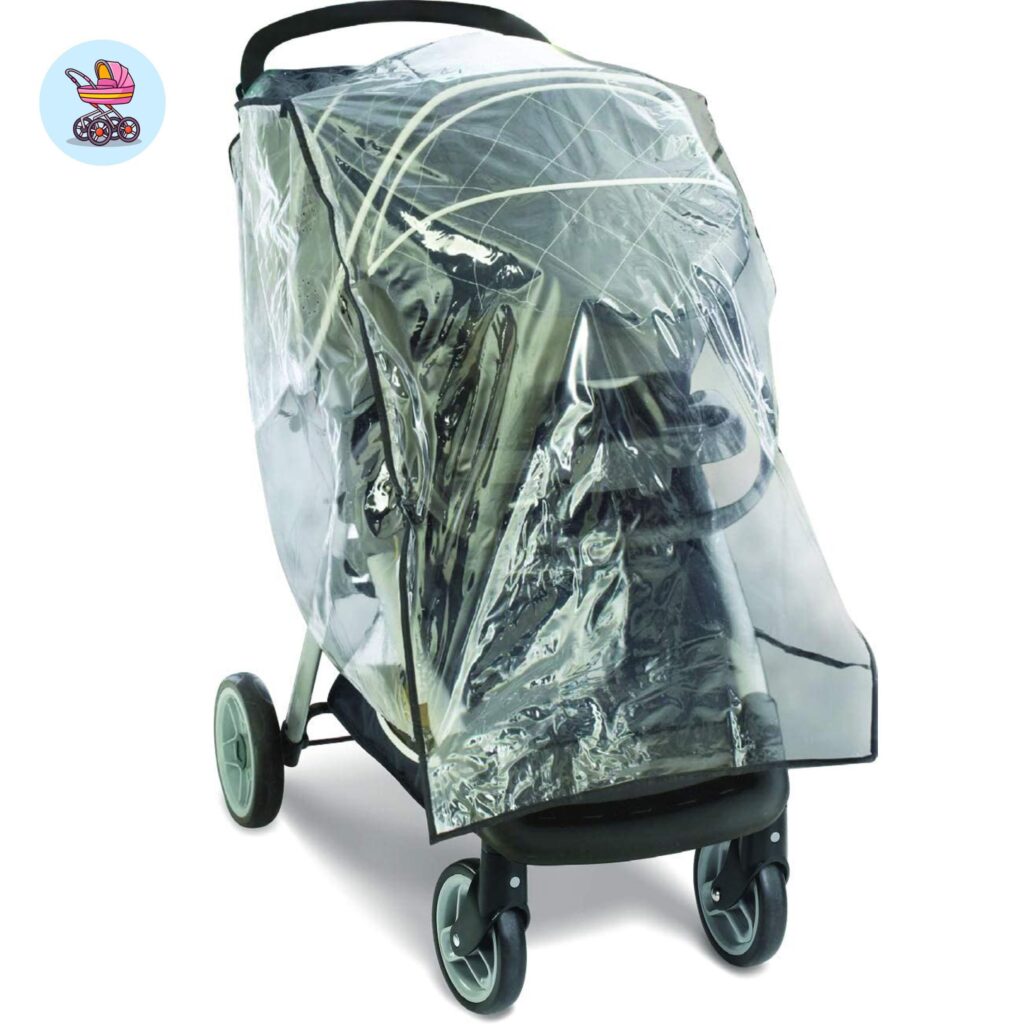
If you own a Graco travel system, this is the cover to buy. The fit is noticeably tighter than a universal option on the same stroller — the seal holds better in wind.
Pros:
- Designed for Graco travel system compatibility
- Excellent waterproof and windproof coverage
- Proper ventilation for airflow
- Sun and weather protection in one
- Easy to wipe clean
Cons:
- Best performance on Graco systems specifically
- Higher cost than generic universal covers
5. Dual-Window Stroller Rain Cover – 360° Visibility Weather Shield with Side Ventilation
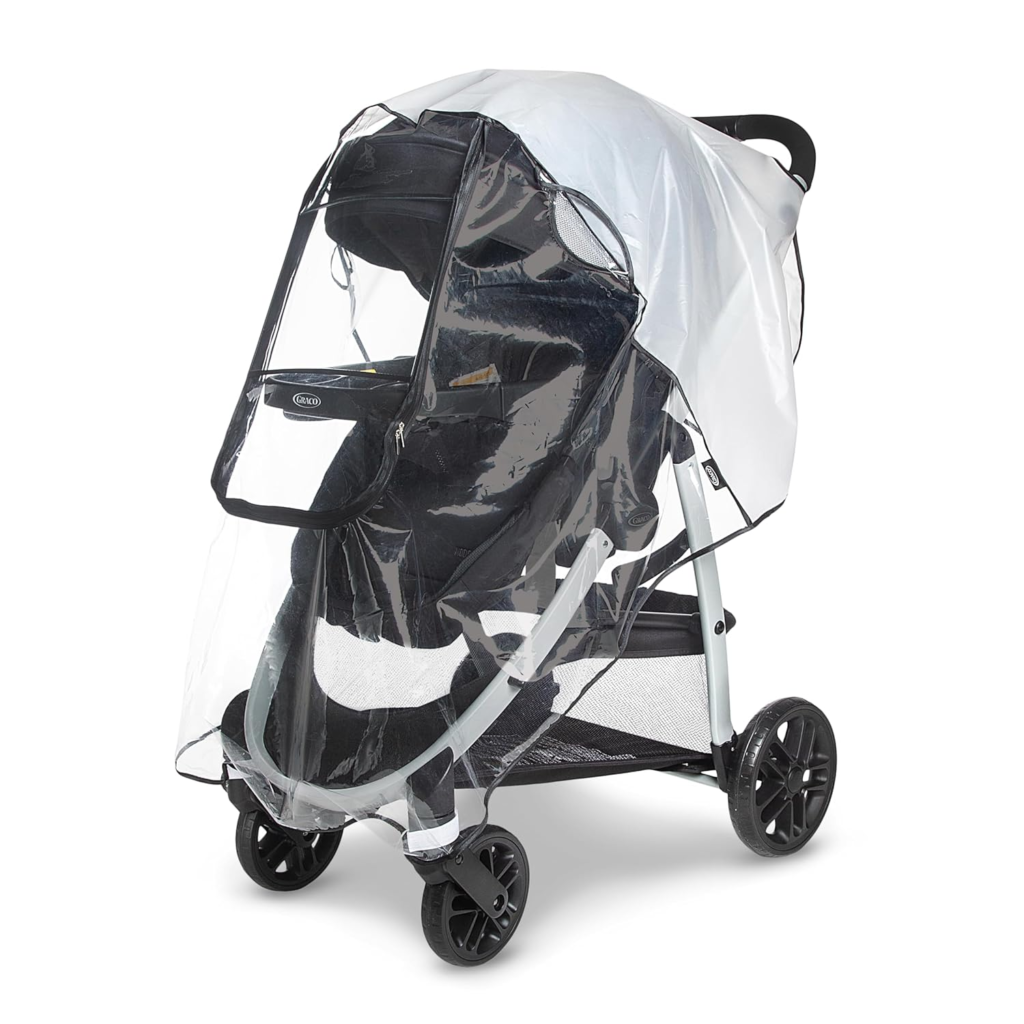
Built for parents who want their child to see out from both sides, not just through the front. Ventilation windows on both sides reduce fogging better than single-vent designs, and the clear material stays transparent through repeated use — a solid pick if your last cover left your toddler staring at plastic instead of the world outside.
Pros:
- Strong waterproof and windproof performance
- Dual ventilation windows
- Clear material for baby visibility
- Fits jogging strollers and standard pushchairs
- Good value relative to features
Cons:
- Plastic smell initially after unpacking (airs out within a day or two)
- Ventilation may fog slightly in very high humidity
9. Which Stroller Rain Cover Is Right for You?
The five covers above aren’t interchangeable — they’re built for different parents in different situations.
If you have a standard single stroller and want solid protection without spending much, Option 1 or Option 2 gets the job done. Neither will impress you with premium features, but both will keep your child dry on a daily commute.
If your stroller is a jogging stroller or an XL frame, Option 3 is the right call. The extra room matters — a tight cover on a wide stroller pools water at the seams and restricts the ventilation it was designed to provide.
If you own a Graco travel system, buy the Graco-specific cover (Option 4). Model-specific covers earn their premium through fit, and a proper fit in wind is noticeably better than a universal cover that lifts at the edges.
For parents who walk daily in unpredictable weather and want the best balance of rain protection, ventilation, and visibility, Option 5 is the most well-rounded choice in this group.
10. How to Clean and Store a Stroller Rain Cover (So It Lasts)
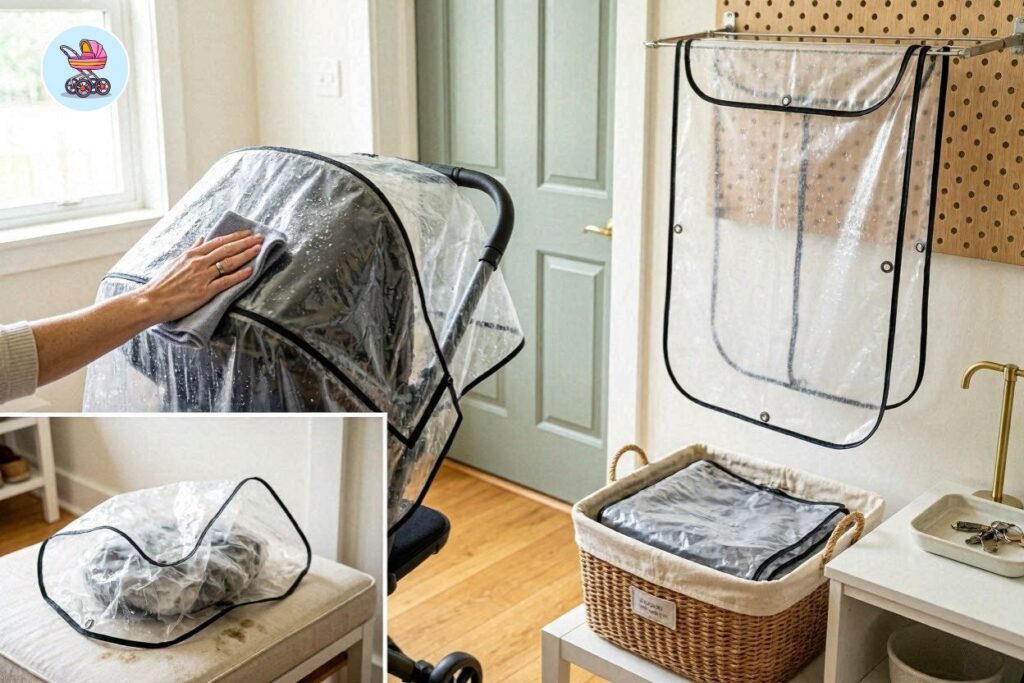
Most parents don’t clean their rain cover until it smells like something went wrong. Don’t wait that long.
After every rainy outing, shake off standing water and wipe the interior with a soft cloth. That’s it — two minutes. The mistake is folding a wet cover and stuffing it into the stroller basket, where it sits damp and develops mildew inside the folds.
For a proper clean, use lukewarm water and a small amount of mild dish soap. Wipe both sides, rinse well, and hang it to air dry completely — never fold it while wet. Avoid machine washing; most EVA and TPU materials aren’t built for it, and agitation can damage the seams over time.
For storage, a resealable gallon bag or the cover’s original pouch keeps it clean and compact. Store it out of direct sunlight when possible — UV exposure yellows clear plastic over time and weakens seams. A cool, dry spot in your stroller basket or diaper bag is fine.
One practical habit: wipe and hang the cover every time you come in from rain. Two minutes of effort is the difference between a cover that lasts one season and one that lasts three.
11. Frequently Asked Questions
Are stroller rain covers safe for newborns?
Yes — with one non-negotiable condition: the cover must have real ventilation openings, and those openings must stay unobstructed. Newborns can’t move away from heat buildup the way older babies can, so check on them more frequently and remove the cover the moment the weather warms or the interior feels humid. For material, stick to EVA or TPU — avoid PVC, especially with very young infants.
Do stroller rain covers pose a suffocation risk?
Not when used correctly, but this is worth taking seriously rather than dismissing. A rain cover is a shield, not a sealed enclosure — it should never fully zip or seal shut without a ventilation gap left open, and it should never be draped over a stroller in a way that blocks the openings a manufacturer built in. The actual risk isn’t the cover itself, it’s a cover with no ventilation, or a good cover used with its vents accidentally blocked by a blanket or bag. Buy a cover with confirmed mesh or vented panels, keep those panels clear, and check on your child periodically — that’s what makes the difference between a safe shield and a real hazard.
How do I know if a rain cover fits my stroller?
Check your stroller’s canopy width — most manufacturers list this in the product specs. Universal covers typically fit canopies between 15 and 19 inches wide. If your stroller falls outside that range (jogging strollers and some double strollers often do), look for an XL universal option or a model-specific cover from your stroller’s brand.
Can I use a rain cover with a car seat attached to my stroller?
It depends on the cover. Most standard stroller rain covers are cut for the stroller seat’s shape and don’t account for the extra height and bulk of an infant car seat clipped onto a travel system frame — you’ll often find the cover doesn’t stretch far enough or leaves gaps around the car seat’s base. If you regularly use your stroller as a travel system, check the product listing specifically for “travel system compatible” or “car seat compatible” wording before buying, or look at a car-seat-specific rain cover instead of a general stroller one.
Can I use a stroller rain cover in summer?
Only with active ventilation management. In warm or sunny conditions, temperatures inside a covered stroller can climb quickly. If you use a cover in summer, open every vent, limit the time the cover is on, and remove it entirely in direct sunlight. A light muslin draped over the stroller is a better summer alternative for sun protection.
How do I stop my stroller rain cover from fogging up?
The cause is almost always blocked ventilation. Open all mesh or vented panels before moving. If your cover doesn’t have vents — return it and get one that does. Keep a small microfiber cloth accessible to wipe the viewing window quickly if condensation builds up anyway.
Will a stroller rain cover fit a double stroller?
Standard universal covers don’t fit most double strollers — the canopy geometry is too wide. You need a cover specifically labeled for double or side-by-side strollers. These exist but require careful measurement before buying. Check the cover’s stated dimensions against your stroller’s canopy width and depth before ordering.
Is a stroller rain cover worth buying if I live somewhere it barely rains?
Probably yes — but not necessarily for rain. A cover that blocks wind on a cold day, keeps road dust off during a walk, or shields your child from a brief shower during a trip is still useful several times a year. If you travel, it earns its keep on airport tarmacs and theme park walkways alone. That said, if you genuinely never go outside in bad weather, it’s not a priority purchase.
How long can my baby stay under a rain cover?
There’s no fixed number, but it’s not meant for hours at a stretch. In mild, cool weather, a healthy baby is fine under a well-ventilated cover for as long as the walk takes, as long as you’re checking on them periodically. In colder conditions — below freezing — keep outings short, closer to 15–30 minutes, and warm your child up indoors afterward. The cover buys you mobility in bad weather, not an excuse to stay out longer than you normally would.
12. Conclusion
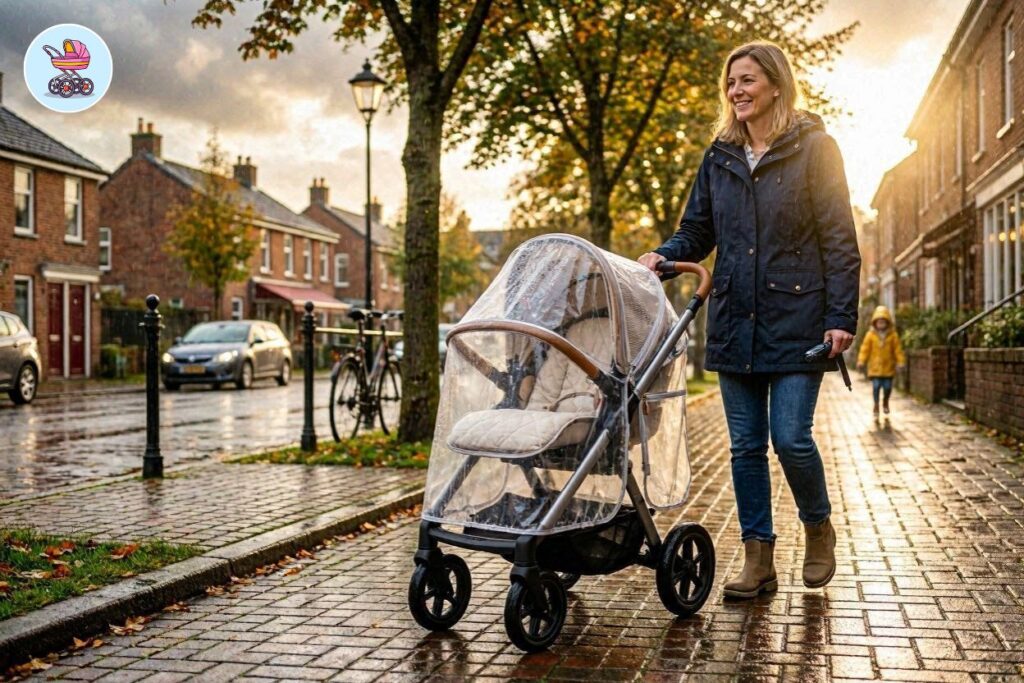
A stroller rain cover is a $20–$50 decision that buys you the ability to leave the house on a Tuesday when it’s raining. That’s it — no complicated calculus required.
Pick a cover with real ventilation, a size that matches your stroller’s canopy, and materials that aren’t PVC. Practice putting it on once at home before you need it in the rain. Take it off when the sun comes back out.
The rest — the walks, the errands, the park days that weather tried to cancel — those you get to keep.
This guide was researched and written by Saim Mughal, founder of Care for Cuties — a resource built on one simple idea: parents shouldn’t have to sort through vague product listings and recycled advice to find gear that actually keeps their kids safe.
Disclaimer: This article provides general guidance for informational purposes only. Always read the manufacturer’s instructions for your specific rain cover and stroller. Never leave your child unattended in a stroller, and ensure your child is properly secured with the provided safety harness at all times. Product availability and pricing are subject to change — verify current details directly with the retailer.
Related Guides
How to Choose a Lightweight Travel Stroller
Best Double Stroller Rain Covers
Best Stroller for Newborn
Best Affordable Car Seat and Stroller
Saim Mughal is the founder of Care for Cuties, testing and comparing baby gear firsthand so parents get advice they can trust, not recycled claims.
5 Responses