
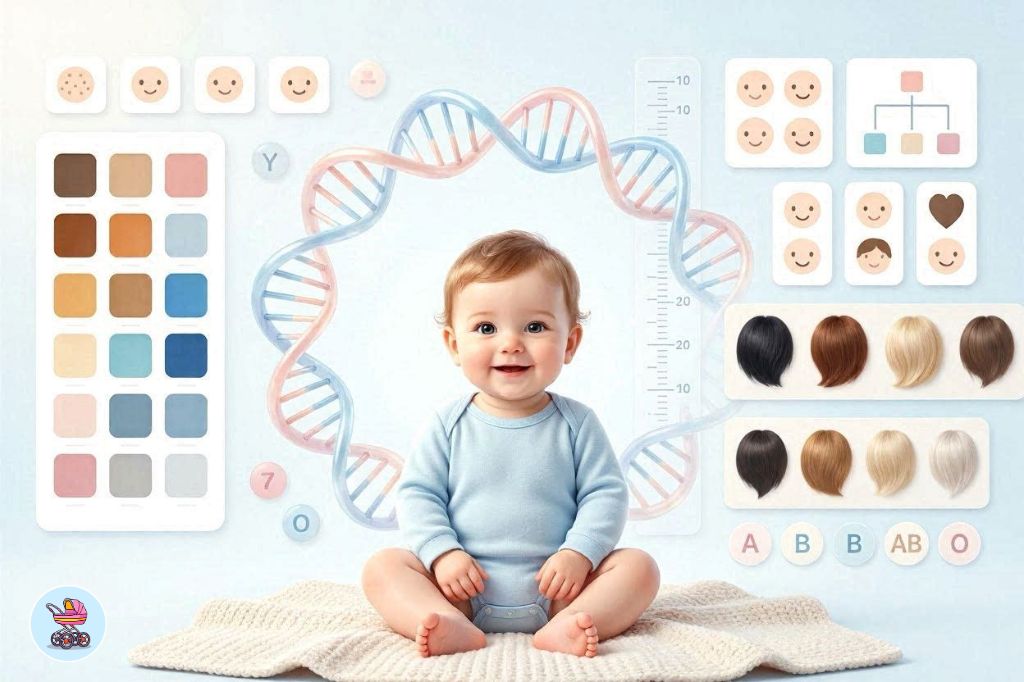
Wondering what your baby will look like? Our baby genetics calculator combines Mendelian genetics with modern research to predict your baby’s eye color, hair color, blood type, Rh factor, height, and physical traits — all in one place.
Enter mom’s and dad’s traits below and see the probabilities instantly.
Baby Genetics Calculator — predict eye color, hair color, blood type, height and more
Baby Genetics Calculator
Predict your baby’s traits using Mendelian genetics & multi-gene inheritance models
Mother
Mom’s traitsFather
Dad’s traitsMother
Blood typeFather
Blood typeMother
Height in cmFather
Height in cmPunnett Square Generator
Single-gene dominant/recessiveTable of Contents
How Does a Baby Genetics Calculator Work?
Every baby inherits two copies of each gene — one from mom, one from dad. These genes come in different versions called alleles. Some alleles are dominant (they show up even if you only have one copy), while others are recessive (they only show up if you have two copies).
A baby genetics calculator uses a tool called a Punnett Square — a simple grid that maps out every possible combination of parents’ alleles — to calculate the probability of each outcome.
Example: If both parents carry one blue-eye allele and one brown-eye allele (heterozygous), there’s a 75% chance the baby has brown eyes and a 25% chance of blue eyes.
These are probabilities, not guarantees. Most traits are influenced by multiple genes simultaneously (called polygenic inheritance), so the actual result can always surprise you.
What Can This Calculator Predict?
1. Baby Eye Color Predictor
Eye color is one of the most-asked baby genetics questions — and one of the most misunderstood.
The old myth: Blue-eyed parents can only have blue-eyed babies. The truth: That’s wrong. About 1% of blue-eyed parent pairs produce brown-eyed babies, because eye color is controlled by at least 10 interacting genes, primarily OCA2 and HERC2.
| Parent Combination | Blue Eyes | Green Eyes | Brown Eyes |
|---|---|---|---|
| Blue + Blue | ~99% | ~1% | <1% |
| Brown + Blue | ~50% | ~14% | ~37% |
| Brown + Brown | ~6% | ~12% | ~75% |
| Green + Green | ~25% | ~75% | <1% |
| Green + Blue | ~50% | ~33% | ~14% |
Important: Most babies are born with grey-blue eyes that darken between 6–12 months as melanin production increases. Your baby’s final eye color may not be set until their first birthday.
Want to explore this in more depth? See our dedicated Baby Eye Color Calculator.
2. Baby Hair Color Predictor
Hair color follows similar inheritance patterns to eye color — multiple genes, multiple surprises.
Key facts:
- Dark hair is generally dominant over light hair
- Red hair is recessive — both parents must carry the MC1R gene variant
- Two dark-haired parents can absolutely have a blonde baby if both carry the recessive allele
- Hair color frequently changes through childhood; your baby’s newborn hair color is not permanent
| Parent Combination | Dark Hair | Medium/Brown | Blonde | Red |
|---|---|---|---|---|
| Dark + Dark | ~75% | ~18% | ~5% | ~2% |
| Dark + Blonde | ~50% | ~30% | ~18% | ~2% |
| Blonde + Blonde | ~5% | ~25% | ~68% | ~2% |
| Either parent red | varies | varies | varies | 25–100% |
For a full breakdown of hair color genetics, check our Baby Hair Color Calculator.
3. Baby Blood Type Calculator
Blood type is one of the most precisely predictable traits in genetics. It follows strict Mendelian rules across three alleles: A, B, and O.
- A and B are co-dominant (both express if present)
- O is recessive (only expresses when you have two O alleles)
Blood Type Inheritance Table:
| Mom’s Type | Dad’s Type | Possible Baby Blood Types |
|---|---|---|
| O | O | O only |
| A | O | A or O |
| B | O | B or O |
| A | A | A or O |
| B | B | B or O |
| A | B | A, B, AB, or O |
| AB | O | A or B |
| AB | A | A, B, or AB |
| AB | B | A, B, or AB |
| AB | AB | A, B, or AB |
Why does this matter beyond curiosity? Blood type is critical for emergency transfusions, organ compatibility, and understanding hemolytic disease of the newborn — which is where Rh factor becomes equally important.
4. Rh Factor Predictor
The Rh factor is a separate protein on red blood cells. You’re either Rh-positive (+) or Rh-negative (−).
Rh-positive is dominant. An Rh-negative baby is only possible if both parents carry the negative allele.
| Mom’s Rh | Dad’s Rh | Baby Rh Possibilities |
|---|---|---|
| Rh+ | Rh+ | 25–100% positive |
| Rh+ | Rh− | 50% positive, 50% negative (if mom is a carrier) |
| Rh− | Rh+ | 50% positive, 50% negative (if dad is heterozygous) |
| Rh− | Rh− | 100% Rh-negative |
Medical note: If an Rh-negative mom carries an Rh-positive baby, there’s a risk of Rh incompatibility in subsequent pregnancies. This is why Rh factor testing is a standard part of prenatal care. Always discuss your Rh status with your OB or midwife.
5. Baby Height Predictor (Mid-Parental Height Formula)
Height is highly polygenic — influenced by hundreds of genes plus nutrition, health, and environment. The most reliable simple estimate is the Mid-Parental Height (MPH) formula, used routinely by pediatricians:
For a boy: (Mom’s height + Dad’s height + 5 inches) ÷ 2
For a girl: (Mom’s height + Dad’s height − 5 inches) ÷ 2
The result gives a target height with a ±2 inch range in either direction.
Example: Mom is 5’4″ (64″), Dad is 5’10” (70″)
- Predicted boy height: (64 + 70 + 5) ÷ 2 = 69.5″ → ~5’9½”
- Predicted girl height: (64 + 70 − 5) ÷ 2 = 64.5″ → ~5’4½”
This formula has about 70–80% accuracy within the ±2 inch range. Outliers happen — genetics is probabilistic, not deterministic.
6. Other Genetic Traits
Our calculator also covers several Mendelian single-gene traits where prediction accuracy is higher:
| Trait | Dominant | Recessive |
|---|---|---|
| Dimples | Present | Absent |
| Cleft Chin | Present | Absent |
| Widow’s Peak | Present | Absent (straight hairline) |
| Attached Earlobes | Absent | Attached |
| Freckles | Present | Absent |
| Hitchhiker’s Thumb | Absent | Present (hyperextensible) |
These single-gene traits are more predictable than eye color or height, but still not guaranteed — environmental factors and gene interactions can shift outcomes.
How Accurate Is a Baby Genetics Calculator?
Honest answer: moderately accurate for some traits, rough estimates for others.
| Trait | Accuracy Level | Why |
|---|---|---|
| Blood Type | High (>95%) | Follows strict Mendelian rules |
| Rh Factor | High (>95%) | Simple dominant/recessive |
| Single-gene traits (dimples, etc.) | Moderate (70–85%) | One gene, but expression varies |
| Eye Color | Moderate (60–80%) | 10+ interacting genes |
| Hair Color | Moderate (55–75%) | Multiple genes, changes with age |
| Height | Rough estimate (±2 inches) | Hundreds of genes + environment |
Every baby also acquires 60–70 new genetic mutations that neither parent has. This is why siblings can look dramatically different even with identical parents.
Use this calculator for fun and curiosity — not medical decisions. For health-related genetic questions (carrier status, hereditary conditions), speak with a certified genetic counselor.
Frequently Asked Questions
What will my baby look like?
No calculator can tell you exactly — genetics involves too much randomness. But based on both parents’ traits, our tool gives you the most likely outcomes with probability percentages. The biggest factors are eye color, hair color, and skin tone, all of which follow recognizable inheritance patterns.
Can I predict my baby’s eye color before birth?
Yes, with reasonable accuracy. If both parents have brown eyes, there’s roughly a 75% chance your baby will too. But because eye color is controlled by 10+ genes, surprises happen. Our Baby Eye Color Calculator breaks this down in full detail.
What blood type will my baby be?
Blood type is the most predictable trait in this calculator. Enter both parents’ blood types and you’ll get every possible outcome with exact probabilities. Some combinations make certain types impossible — for example, two type-O parents can only have a type-O baby.
Can two blue-eyed parents have a brown-eyed baby?
Yes, though it’s rare — approximately 1% chance. This was considered genetically impossible until modern research revealed the complexity of the OCA2-HERC2 gene interaction.
Is hair color dominant or recessive?
Dark hair is generally dominant over blonde or red hair. Red hair is recessive, requiring the MC1R gene variant from both parents. However, hair color is polygenic, so these are tendencies, not absolute rules.
What is a Punnett Square?
A Punnett Square is a grid used by geneticists to map out all possible allele combinations from two parents. Each square in the grid represents a 25% probability. Our calculator uses Punnett Square logic under the hood to generate all its predictions.
How do I know my baby’s Rh factor?
Your Rh factor is determined by blood tests — yours and your partner’s. If you don’t know your Rh status, your OB will test it at your first prenatal appointment. It’s one of the most medically important tests in early pregnancy.
Can genetics predict twins?
Fraternal (dizygotic) twins have a heritable component — if the mother’s family has a history of fraternal twins, her chances increase slightly. Identical (monozygotic) twins are considered a random developmental event with no established genetic link.
The Science Behind This Calculator
This calculator is built on established principles from Mendelian genetics and updated with findings from modern genomic research. Key references include:
- Studies on OCA2 and HERC2 gene interactions for eye color prediction
- MC1R gene research for red hair inheritance
- ABO blood group system established by Karl Landsteiner
- Rhesus factor research and its obstetric implications
- Mid-parental height formula as used in pediatric growth assessment
- Polygenic trait research from genome-wide association studies (GWAS)
We do not incorporate paternal or maternal grandparent data because research shows this changes outcome probabilities by only 2–5% — not worth the additional input complexity.
Track Your Baby’s Growth After Birth
Once your little one arrives, you may want to monitor their early health milestones. Check out our Newborn Weight Loss Calculator — a tool used by pediatric nurses to track whether a newborn’s initial weight loss is within safe limits.
Saim Mughal is the founder of Care for Cuties, testing and comparing baby gear firsthand so parents get advice they can trust, not recycled claims.
This calculator is for educational and entertainment purposes. It does not provide medical advice. Consult a qualified healthcare provider or genetic counselor for clinical genetic questions.