
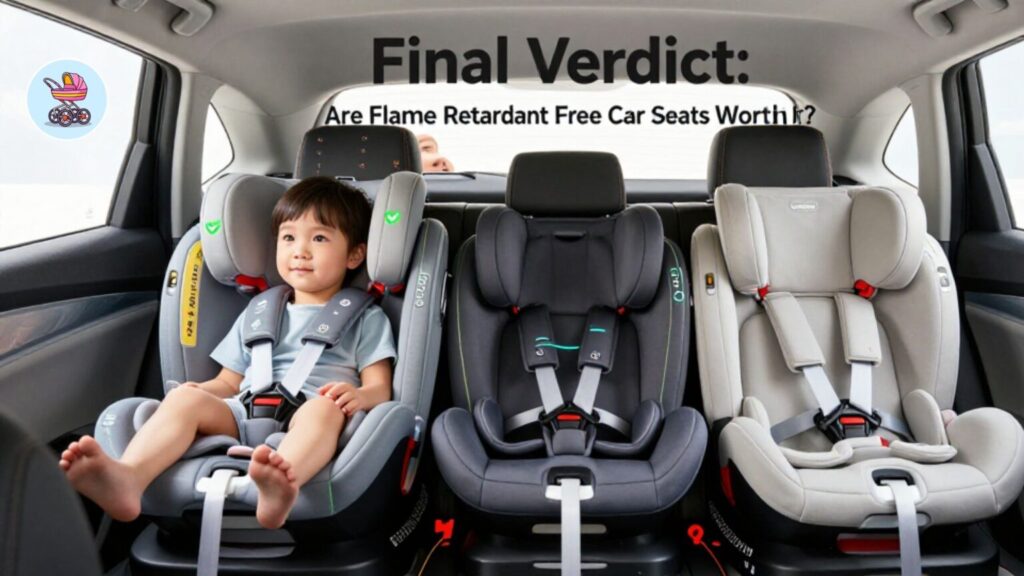
Baby number three is coming, and suddenly the math in your back seat doesn’t work. You’ve got a 4-year-old in a booster, a toddler rear-facing, and now an infant seat that needs to go… somewhere. You climb into the back seat with a tape measure, wedge yourself between two headrests, and start doing calculations you never thought you’d need.
Here’s the number that makes this feel impossible: three standard car seats at 19–20 inches each need 57–60 inches of usable width. Most midsize SUVs only give you 52–55 inches between the door panels. On paper, it doesn’t fit.
But thousands of families make this work every week — not by buying a bigger car, but by choosing the right seats, placing them in the right order, and installing at least one of them with the seat belt instead of LATCH. Here’s exactly how to do it.
Table of Contents
Why Fitting Three Car Seats Across Is Harder Than It Looks
The math is the first problem. Three standard-width car seats at 19 inches each add up to 57 inches. Most midsize SUV back seats only offer 52–55 inches of actual usable space.
Here’s the thing most parents don’t realize: total hip room is not the same as usable space. The inches near the door — between the door panel and the seat belt buckle anchor — are largely wasted. Car seats can’t sit there safely.
LATCH anchors create another constraint. They’re usually centered on each seating position, which forces car seats to install right in front of them. That limits how much you can shift seats toward the doors to create center space.
NHTSA’s official car seat and LATCH guidance recommends always checking your vehicle owner’s manual for weight limits and anchor positions before you install anything — LATCH hardware isn’t rated the same across every seating position. Understanding your anchor locations is the first step to planning a three-across setup.
Quick Tip: Measure from seat belt buckle anchor to seat belt buckle anchor — not door to door. That middle number is your true usable back seat width.
If you’re also researching which car seats are built narrow from the start, our guide to slim car seats covers the full category.
What to Look for in a Three-Across Car Seat
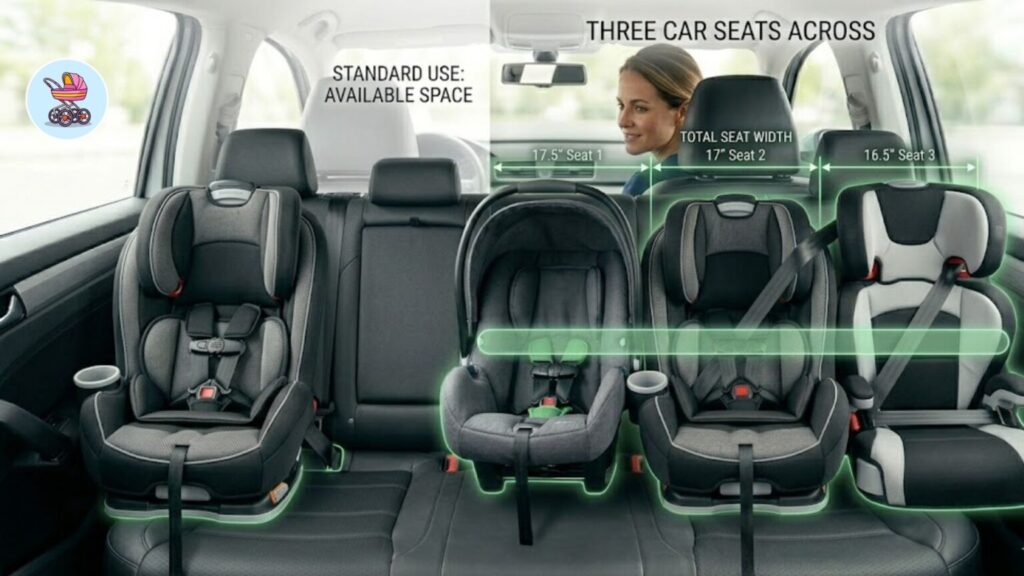
Not every slim-looking seat is actually slim where it counts. Here are the four things that actually determine whether a seat works in a three-across setup.
Seat Width: The Number That Actually Matters
Target seats under 17 inches wide for a three-across setup. That’s the general cutoff between a true slim/narrow seat and a standard-width seat.
One important note: some manufacturers list the shell width while others list the base width. These can differ by an inch or more. Always check both measurements before you buy.
Top Slim Car Seats: Width at a Glance
| Car Seat | Type | Width | Weight Range |
|---|---|---|---|
| Graco SlimFit3 LX | Convertible / 3-in-1 | 16.7″ | Rear-Facing: 5–40 lbs / Forward-Facing: 26.5–65 lbs |
| Clek Foonf | Convertible | 16.9″ | Rear-Facing: 14–50 lbs / Forward-Facing: 22–65 lbs |
| Britax Poplar | Convertible | ~17″ | Rear-Facing: 5–50 lbs / Forward-Facing: 22–65 lbs |
| Chicco Fit3x | Convertible / 3-in-1 | ~17″ | Rear-Facing: 5–40 lbs / Forward-Facing: 22–65 lbs |
| Diono Radian 3RXT | Convertible | 17″ | Rear-Facing: 5–50 lbs / Forward-Facing: 22–65 lbs |
| Britax One4Life Slim | All-in-One | 17.5″ | Rear-Facing: 5–50 lbs / Forward-Facing: 22–65 lbs / Booster: 40–120 lbs |
| Nuna PIPA RX | Infant | 17.5″ (Base: 12.2″) | 4–32 lbs |
LATCH vs. Seat Belt Installation
For three-across setups, seat belt installation is often the better choice for the outboard seats — even if LATCH anchors are available.
LATCH anchors are centered on each seating position. That centering restricts where the seat sits. With a seat belt install, you can shift the seat an inch or two toward the door — freeing up precious space in the center for the third seat.
Look for seats with built-in belt lock-offs. These make seat belt installation simple and secure, without the wrestling match.
The American Academy of Pediatrics recommends always reading both your car seat manual and vehicle owner’s manual before installation — especially in tighter multi-seat setups where an inch of misplacement changes whether the whole row fits.
Center Seat Strategy
The center seat is often the tightest position, and it almost never has LATCH anchors available. Plan on a seat belt install there, and choose the slimmest seat in your lineup for the middle spot.
Rear-facing in the center position is statistically the safest location, but it’s also the hardest to buckle. Many families compromise by placing a forward-facing or booster seat in the center when three kids are all different ages.
If you’re weighing LATCH anchor options for infants specifically, our lower anchors guide for infants explains exactly when LATCH is — and isn’t — the right call.
FMVSS 213a: What the 2026 Standard Means for Slim Seats
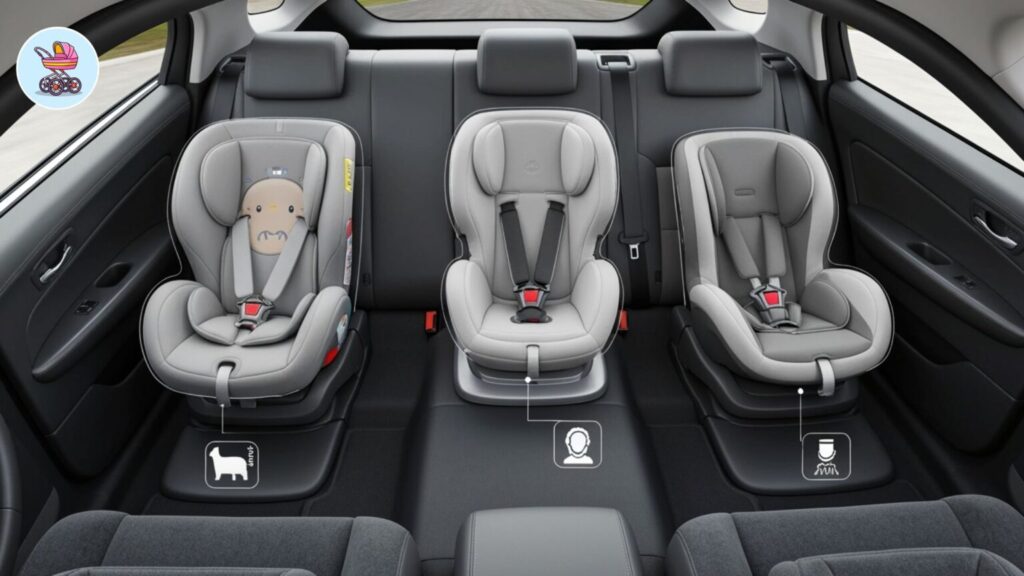
It’s not on most parents’ radar yet, but it matters a lot if you’re buying slim seats right now.
FMVSS 213a is a new federal side-impact safety standard for car seats. The mandatory compliance date is December 5, 2026. After that date, all newly manufactured seats must pass a 30 mph side-impact sled test — not just the frontal crash testing that’s been the standard for decades.
Here’s the catch: some ultra-narrow seats may need design changes to comply. That could mean slightly wider headwings or added foam — which could change the fit in tight three-across setups.
The good news: many seats already meet FMVSS 213a ahead of the deadline. When shopping now, look for seats already tested to this standard. The Graco SlimFit3 LX, for example, includes side-impact testing in its ProtectPlus Engineering.
The Mixed-Age Family Setup: Infant + Toddler + Older Child
Most families aren’t fitting three identical seats. The real-world scenario is almost always a mix — a baby in an infant seat, a toddler rear-facing, and an older child in a forward-facing seat or booster.
This actually works in your favor. Mixing rear-facing and forward-facing seats lets the widest parts of each seat nest into each other. A rear-facing seat is tall and narrow at the base. A forward-facing seat is wider at the top. They fit together better than three identical seats.
Real Parent Scenario: “When baby #3 arrived, I had a 4-year-old in a booster and a 2-year-old rear-facing. Putting the Graco SlimFit3 LX in the center made it work in our Honda Pilot — just barely. The seat belt install on the booster shifted it two inches toward the door and that was the difference.”
Mixed-Age Setup Guide
| Child Ages / Stages | Recommended Setup | Key Tip |
| Infant + Toddler RF + 4–8yr FF | Infant outboard, RF convertible center, FF outboard | Install infant base toward door to save center room |
| 3 convertible seats | All slim seats under 17″ wide | Use seat belt install for both outboard seats |
| Toddler RF + 2 boosters | Slim convertible center + slim boosters outboard | Boosters take least width — easiest setup |
Planning ahead for your infant’s seat? Our guide to the best infant car seats covers the narrowest options with the best safety features.
Which Vehicles Actually Fit Three Car Seats Across?
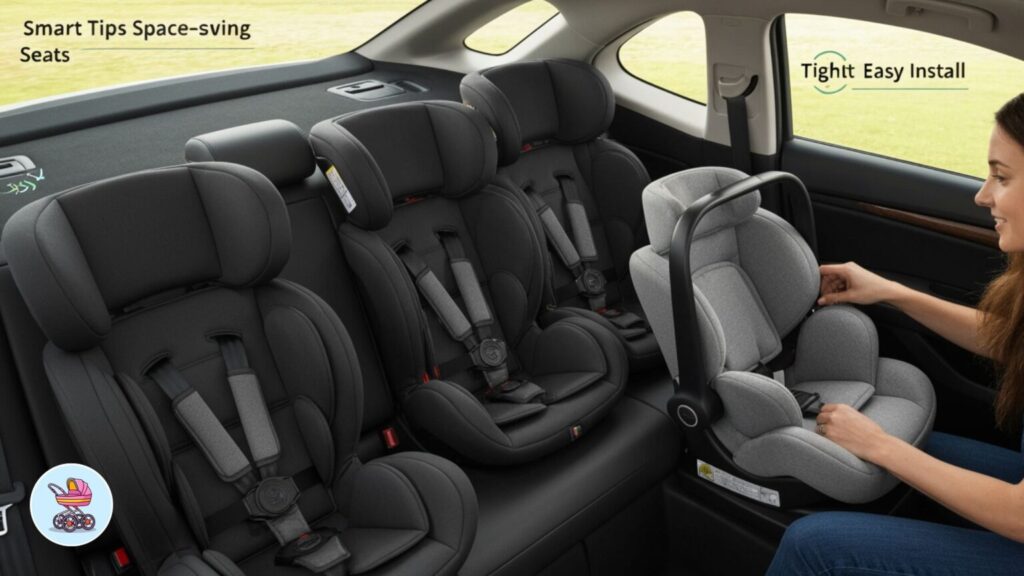
The vehicle matters as much as the seats. Here’s a quick breakdown of what to expect from each vehicle type.
Minivans are the gold standard. The Honda Odyssey and Chrysler Pacifica both offer three full sets of LATCH hardware across the second row, giving you maximum flexibility. The Pacifica’s second-row bench opens up five possible child safety seat positions total.
Three-row SUVs like the Subaru Ascent, Volkswagen Atlas, and Toyota Sienna can work well — especially with a second-row bench rather than captain’s chairs. Captain’s chairs eliminate the center seating position entirely.
Midsize SUVs are doable but tight. You’ll need slim seats under 17 inches in every position, and seat belt installation on at least the outboard seats.
Compact SUVs and sedans are the biggest challenge. It’s possible with ultra-slim seats and careful planning, but measure your usable width first — don’t guess.
Quick Vehicle Guide for Three Across
| Vehicle Type | 3-Across Feasibility | Notes |
| Minivan | ✅ Easiest | 3 LATCH sets standard; most space |
| 3-Row SUV | ✅ Usually works | Choose bench seat over captain’s chairs |
| Midsize SUV | ⚠️ Depends on seats | Slim seats under 17″ needed; measure first |
| Compact SUV / Sedan | ❌ Challenging | Ultra-slim seats only; seat belt installs required |
How to Measure Your Back Seat Before You Buy
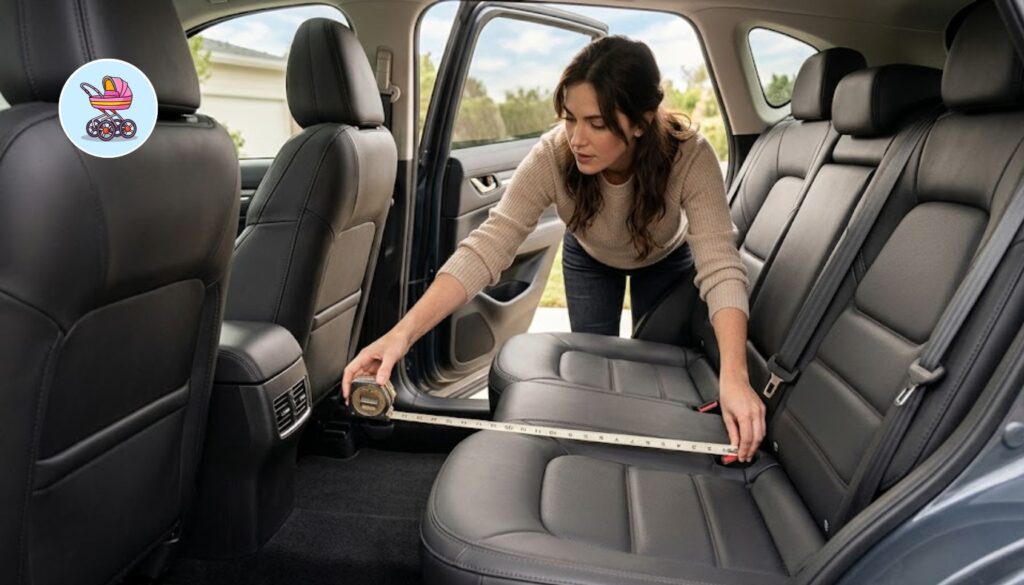
This step alone can save you from a very frustrating return. Measure before you order — not after.
- Push your front seats to a normal driving position for a 6-foot driver.
- Sit in the back seat and locate the seat belt buckle anchor point on the left outboard position.
- Measure from that anchor point across to the right outboard anchor point.
- That measurement is your usable width — not the door-to-door width.
- Add up the widths of the three seats you’re considering. You need at least 1–2 inches of total clearance for buckle access.
Space-saving tip: Removing cup holders can free up 0.5–1 inch per seat. Many slim seats — including the Graco SlimFit3 LX — have retractable or removable cup holders designed exactly for this.
Installation tip: Switching from LATCH to seat belt installation on outboard seats can shift each seat 1–2 inches toward the door, opening up the center.
Recommended Products
1. Graco SlimFit3 LX — Best Overall for Three Across
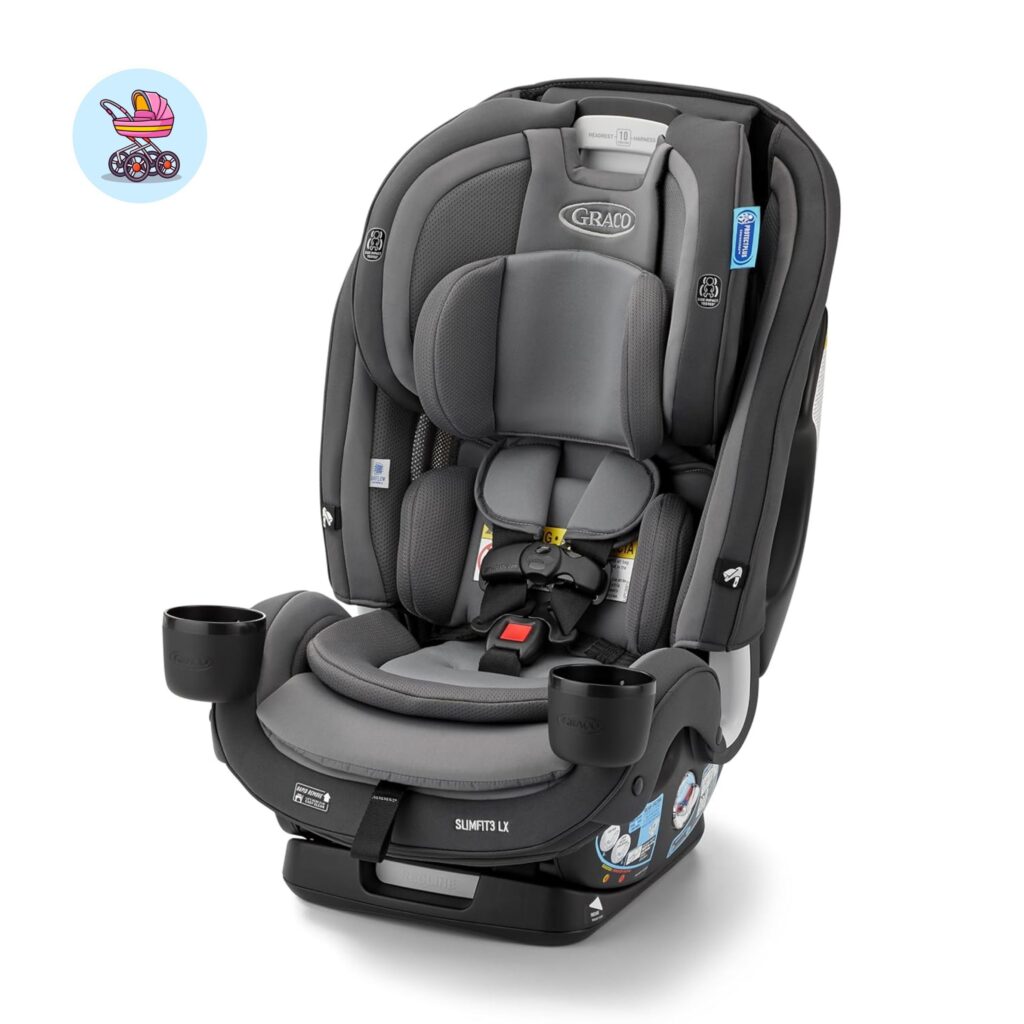
⭐ Best For: Families who want one seat from infancy through booster age
The Graco SlimFit3 LX is the go-to choice for three-across families — and for good reason. At just 16.7 inches wide, it’s one of the narrowest all-in-one convertible seats you can buy in 2026.
What makes it stand out is the combination of width, versatility, and thoughtful design. The retractable cup holders, removable cover (no uninstall needed), and breathable AirFlow mesh make day-to-day life easier for busy families.
Graco built this seat specifically with the three-across scenario in mind — and it shows.
KEY SPECS:
- Width: 16.7 inches
- Rear-Facing: 5–40 lb
- Forward-Facing: 26.5–65 lb (up to 49 inches)
- Highback Booster: 40–100 lb
- Seat Weight: approximately 14 lb
- FMVSS 213 compliant: Yes | Side-Impact tested (FMVSS 213a): Yes
- LATCH and seat belt installation: Yes
PROS:
- ✅ Narrowest 3-in-1 convertible on the market at 16.7 inches
- ✅ Retractable cup holders free up space in tight setups
- ✅ InRight LATCH for one-second secure click
- ✅ Cover removes in 60 seconds without uninstalling — great for messes
- ✅ Breathable AirFlow mesh keeps kids comfortable on longer rides
CONS:
- ❌ Lower rear-facing weight limit (40 lb) vs. some slim competitors (50 lb)
- ❌ Less premium feel compared to Clek or Britax options
→ Read our full Graco SlimFit3 LX review
2. Britax Poplar — Best for Rear-Facing to 50 Pounds
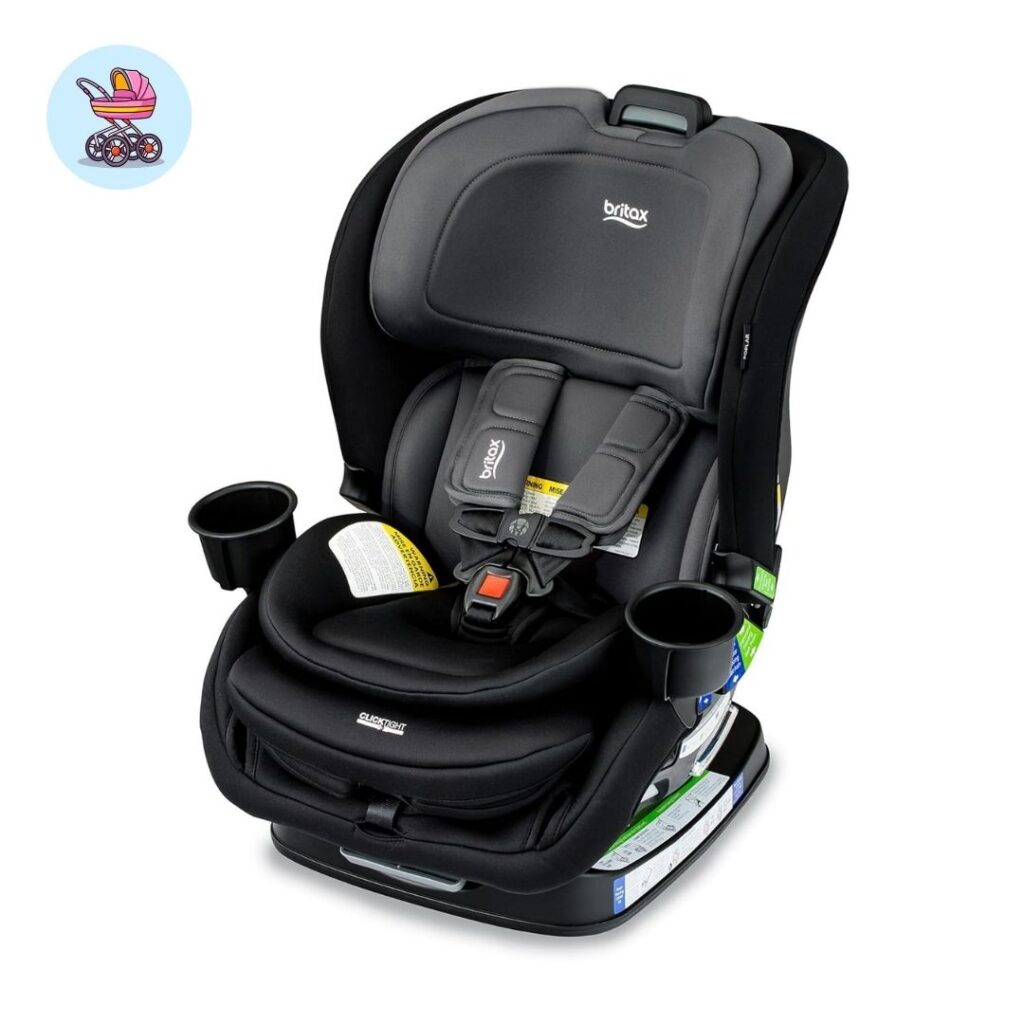
⭐ Best For: Parents keeping kids rear-facing as long as possible
The Britax Poplar is one of the most compact front-to-back slim seats available — which makes it especially useful in vehicles where tall front-seat passengers limit rear-facing clearance.
It’s also one of the only slim seats in this category with a 50-pound rear-facing limit, the highest available in the narrow seat market. If you’re following the AAP’s guidance to keep kids rear-facing as long as possible, the Poplar is built for exactly that.
Britax’s SafeWash fabric is flame-retardant free — a detail that matters to many families choosing their next seat.
KEY SPECS:
- Width: approximately 17 inches
- Rear-Facing: 5–50 lb (up to 49 inches)
- Forward-Facing: 22–65 lb (up to 49 inches)
- No booster mode
- FMVSS 213 compliant: Yes
- Installation: ClickTight (seat belt) + LATCH
- Fabric: SafeWash — flame-retardant free
PROS:
- ✅ Highest rear-facing weight limit (50 lb) in the slim seat category
- ✅ ClickTight installation is one of the easiest and most secure systems available
- ✅ Compact front-to-back — ideal for smaller vehicles or taller front-seat passengers
- ✅ Flame-retardant free SafeWash fabric
- ✅ Machine-washable cover
CONS:
- ❌ No booster mode — you will need a second seat when your child outgrows the harness
- ❌ Higher price point than budget slim options
→ Read our full Britax Poplar review
3. Clek Foonf — Best Premium Slim Convertible
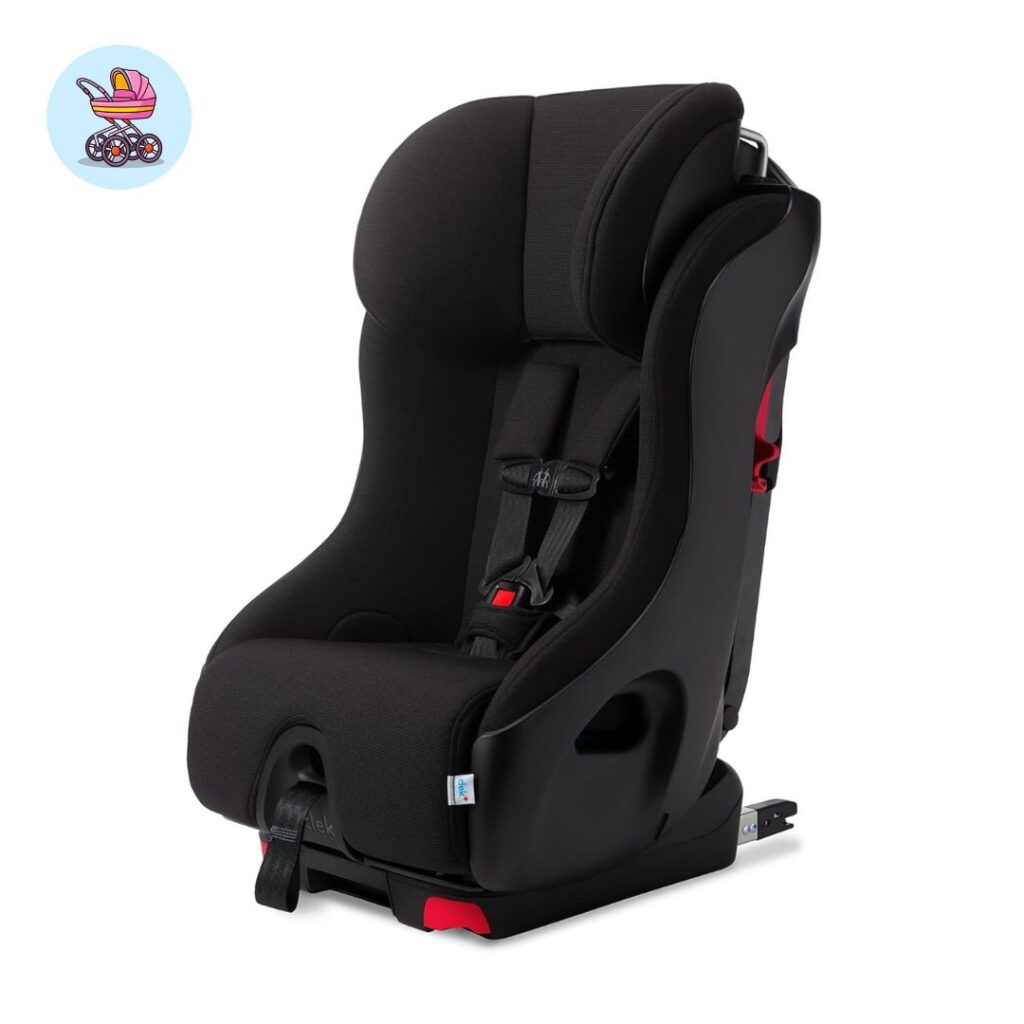
⭐ Best For: Parents who want maximum safety engineering in a slim profile
The Clek Foonf was one of the first narrow convertible seats on the market, and it remains one of the strongest options today. At 16.9 inches wide, it fits comfortably in three-across setups — and its safety engineering goes deeper than most competitors.
The steel-reinforced frame, rigid LATCH connectors, and energy-absorbing EPP foam put it in a class of its own for crash protection. It also works with the optional Infant Thingy insert, which makes it suitable for newborns — a real advantage when you need all three positions to work from day one.
The mandatory anti-rebound bar is a unique safety feature that also creates useful legroom for rear-facing children.
KEY SPECS:
- Width: 16.9 inches
- Rear-Facing: 14–50 lb (with Infant Thingy: from newborn)
- Forward-Facing: 22–65 lb
- No booster mode
- Frame: Steel-reinforced
- LATCH: Rigid LATCH connectors
- FMVSS 213 compliant: Yes
PROS:
- ✅ Steel-reinforced frame — built like a tank
- ✅ Rigid LATCH for ultra-secure, precise installation
- ✅ Works with newborns using the optional Infant Thingy
- ✅ Mandatory anti-rebound bar adds stability and legroom
- ✅ High rear-facing limit (50 lb)
CONS:
- ❌ Higher price point — one of the most expensive slim seats available
- ❌ Heavier than other narrow options — harder to move between vehicles
4. Diono Radian 3RXT — Best for Families Who Travel
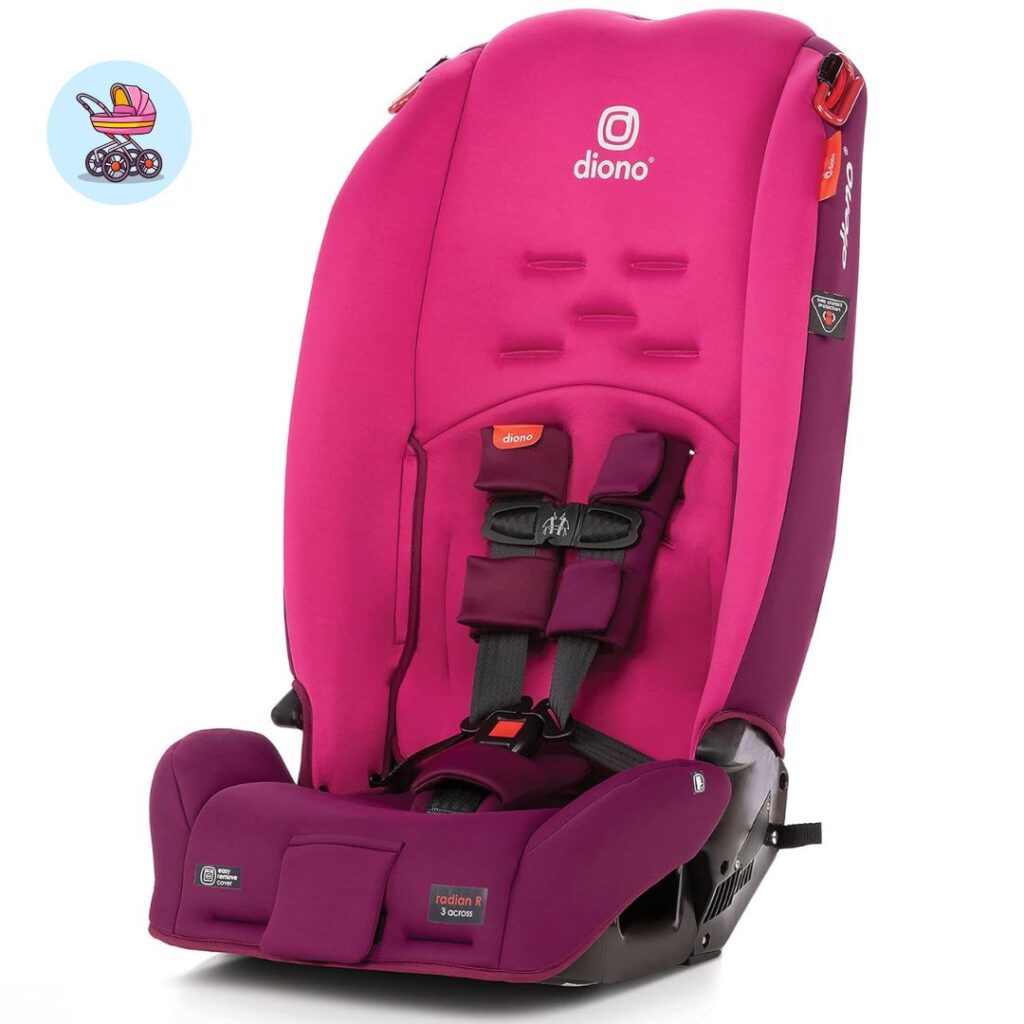
⭐ Best For: Frequent travelers who need a slim seat that folds flat
The Diono brand essentially invented the three-across category — and the Radian 3RXT is still one of the most versatile slim seats available. At 17 inches wide, it works in most midsize and larger vehicles.
What sets it apart for traveling families is that it folds flat. That makes it easier to store on an airplane, in a hotel closet, or in the cargo area between trips. Its 10-year lifespan also means you won’t be replacing it for a long time.
The steel and aluminum frame gives it excellent durability — it’s one of the most solid-feeling seats in this category.
KEY SPECS:
- Width: 17 inches
- Rear-Facing: 5–50 lb
- Forward-Facing: 22–65 lb
- Booster: 50–120 lb
- Folds flat: Yes
- Seat lifespan: 10 years
- FMVSS 213 compliant: Yes
PROS:
- ✅ Folds flat — ideal for travel and storage
- ✅ 10-year lifespan — longest in category
- ✅ Steel and aluminum frame for long-term durability
- ✅ High rear-facing limit (50 lb) and booster mode through 120 lb
- ✅ Works from birth through booster stage
CONS:
- ❌ Heavier than other slim options — harder to carry
- ❌ More expensive than budget slim seats
5. Nuna PIPA RX — Best Slim Infant Seat for Three Across
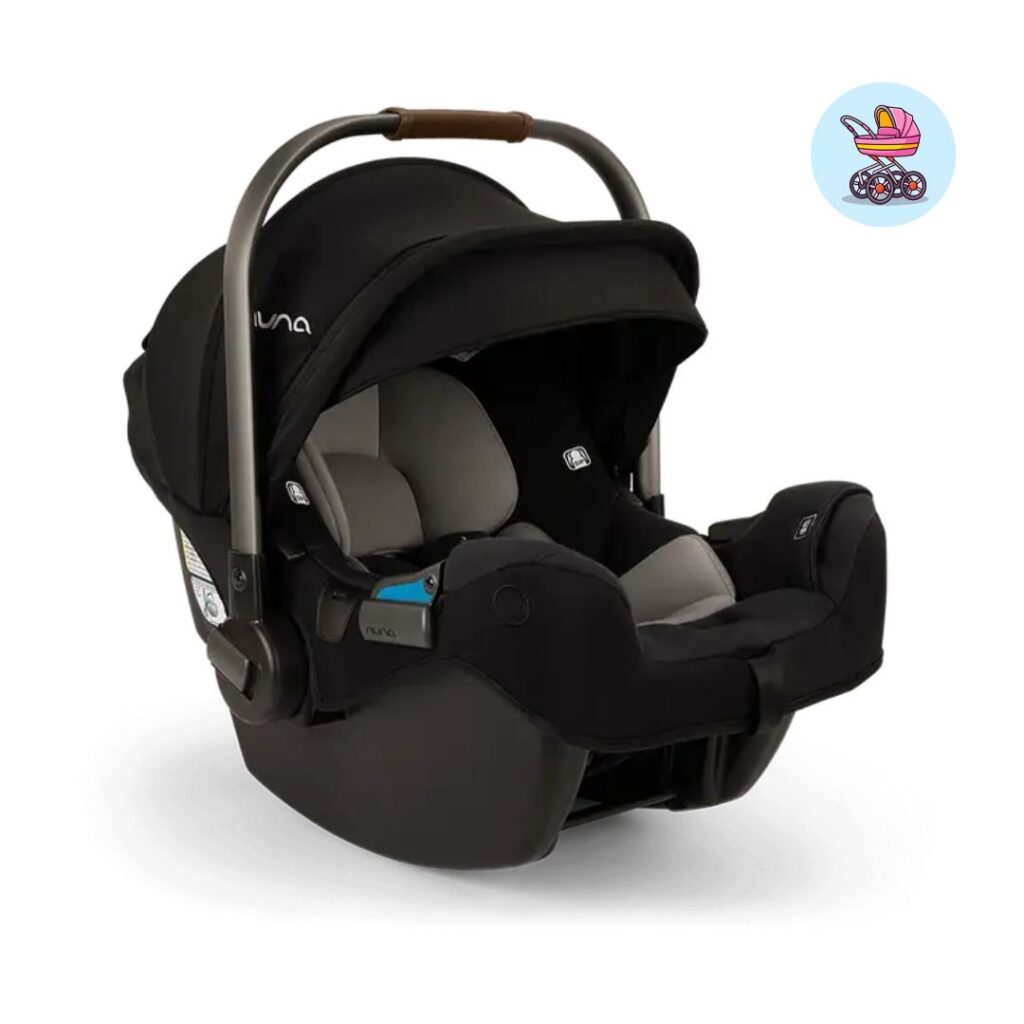
⭐ Best For: Newborns in a three-across setup alongside two older children
When you already have two older kids in car seats and a new baby arriving, the Nuna PIPA RX is the infant seat that fits the gap. Its base is just 12.2 inches wide — narrow enough to install in an outboard or center position without crowding the seats next to it.
The load leg and rigid LATCH system are safety features typically found on convertible seats. Getting them in an infant carrier is unusual and valuable — especially in three-across scenarios where installation precision matters most.
Premium non-toxic materials and a magnetic canopy make it a practical daily driver, not just a safety checkbox.
KEY SPECS:
- Width: 17.5 inches (base: 12.2 inches)
- Weight range: 4–32 lb
- Seat weight: approximately 8.9 lb (without base)
- Load leg: Yes
- Rigid LATCH: Yes
- Anti-rebound panel: Yes
- FMVSS 213 compliant: Yes
PROS:
- ✅ Ultra-compact base (12.2 inches) ideal for tight three-across setups
- ✅ Load leg + rigid LATCH — premium safety features in an infant carrier
- ✅ Anti-rebound panel reduces crash forces
- ✅ Magnetic canopy for easy one-hand open and close
- ✅ Non-toxic, premium materials
CONS:
- ❌ Infant only — shorter use period than convertible seats
- ❌ Premium price point
→ Read our full best infant car seats guide
6. A Few More Slim Options Worth Knowing
Slim car seat shopping moves fast — new narrow models show up every year. A few others worth putting on your radar if the five above don’t quite fit your vehicle:
The Chicco Fit3x is a newer narrow 3-in-1 that’s built specifically for three-across families who already trust Chicco’s KeyFit line. The Britax One4Life Slim trims over two inches off the original One4Life and still covers birth through booster in one seat — useful if you don’t want to buy three separate seats as your kids grow. If you need a seat that swivels for easier buckling, the Evenflo Revolve Slim is currently the narrowest swivel convertible on the market, though it rarely swivels next to another rear-facing seat in the center position.
None of these replace the need to measure your own back seat first — but they’re worth a look if your exact combination of ages and vehicle doesn’t line up with the picks above.
Where to Buy Slim Car Seats — Best Price Today
Amazon is the most reliable place for authorized purchases on all five seats listed here. You’ll get manufacturer warranty coverage, easy returns, and — often — the best current price.
Always buy from an authorized retailer. A car seat bought through an unauthorized third-party seller may have been in a prior crash and cannot be verified as safe.
FAQs — Three Car Seats Across
Can you legally fit three car seats across in one row?
Yes — there is no federal law against having three car seats in one row. You do need each seat installed correctly per the manufacturer’s instructions and your vehicle owner’s manual. Some states have specific child restraint laws, so check your state’s requirements. The key is that every seat must be properly installed and every harness must fit correctly — no exceptions.
What is the narrowest car seat available in 2026?
The Graco SlimFit3 LX is one of the narrowest convertible/all-in-one seats at 16.7 inches. For infant seats, look at base width rather than shell width — the Nuna PIPA RX, for example, has a 12.2-inch base even though the carrier itself is rated at 17.5 inches. Always check whether a listing gives you the shell width or the base width, since manufacturers aren’t consistent about which one they lead with.
Do all three car seats need LATCH anchors?
No. You can use the vehicle seat belt instead of LATCH anchors — and for three-across setups, seat belt installation is often the smarter choice for the outboard seats. LATCH anchors are typically centered on each position, which limits where you can place the seat. A seat belt install lets you shift each seat toward the door, creating more space in the center. The center seat almost never has LATCH anchors available, so a seat belt install is standard for the middle position.
Is the center seat the safest position for a car seat?
NHTSA data has generally found the center rear seat carries a lower injury risk than the outboard positions, mainly because it sits farthest from side-impact crash zones. That said, a correctly installed seat in any rear position is significantly safer than a front-seat installation. Don’t sacrifice a secure, correct install just to force a seat into the center if it doesn’t actually fit there.
Which vehicles fit three car seats across most easily?
Minivans — particularly the Honda Odyssey and Chrysler Pacifica — are the easiest vehicles for three-across setups, with three full LATCH sets in the second row. Three-row SUVs with second-row bench seats (like the Subaru Ascent and Volkswagen Atlas) also work well. Midsize SUVs can work with slim seats. Compact SUVs and sedans are possible but require ultra-slim seats and careful measurement.
Can rear-facing seats fit in a three-across setup?
Yes — and mixing rear-facing and forward-facing seats can actually make the setup easier. Rear-facing seats are typically wider at the top and narrower at the base, while forward-facing seats are wider at the top. When placed side by side, they nest together, creating more combined clearance than three identical seats. Install rear-facing seats with the vehicle seat belt (not LATCH) on outboard positions to gain shifting room.
How wide does my back seat need to be for three car seats?
Measure your usable width — from seat belt buckle anchor to seat belt buckle anchor, not door to door. For three slim seats under 17 inches each, you need approximately 52–53 inches of usable space plus 1–2 inches of clearance for buckle access. Always measure before purchasing rather than relying on total back seat width, which includes unusable door-side space.
Will FMVSS 213a change which slim seats are still available?
Possibly. The new federal side-impact standard (FMVSS 213a) has a mandatory compliance date of December 5, 2026. Some very narrow seats may need design changes — like deeper headwings or added foam — to pass the new tests. That could add a small amount of width. The safest strategy right now is to choose seats already tested and certified to FMVSS 213a, like the Graco SlimFit3 LX, so you’re not buying a seat that may change or be discontinued before the deadline.
The Bottom Line on Three Car Seats Across

Fitting three car seats across is absolutely doable — you just need the right seats, the right strategy, and a tape measure before you shop.
Start by measuring your usable back seat width — not the door-to-door measurement. Then choose slim seats under 17 inches, prioritize built-in belt lock-offs, and plan on seat belt installation for the outboard positions.
The Graco SlimFit3 LX gives you the best combination of narrow width and long-term value for most families. If you’re keeping kids rear-facing longer, the Britax Poplar’s 50-pound limit is hard to beat. And if budget allows, the Clek Foonf’s safety engineering is in a class of its own.
One last tip: once you’ve ordered your seats, get an in-person installation check from a certified Child Passenger Safety Technician (CPST). NHTSA’s inspection station locator can point you to a free check-up near you. A three-across setup deserves a professional set of eyes before you take it on the highway for the first time.
Written by Saim Mughal, founder of Care for Cuties. Saim started this site after living through the exact three-across puzzle himself — measuring back seats, returning seats that didn’t fit, and learning the hard way which specs actually matter. Every recommendation here is tested against real vehicles and real families, not just spec sheets.
4 Responses