Disclosure: This article contains Amazon affiliate links. As an Amazon Associate, I earn from qualifying purchases.
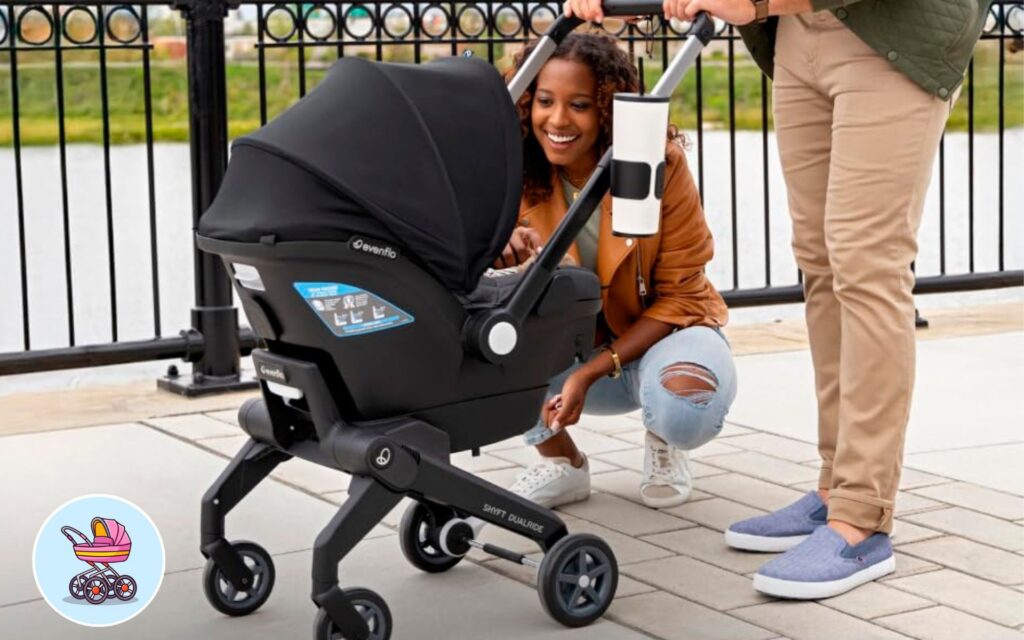
You’re standing in the nursery at 2am, scrolling reviews on your phone, trying to figure out if you really need two separate pieces of baby gear — or if one of these car-seat-stroller hybrids can actually replace both.
That’s the exact decision the Doona and the Evenflo Shyft DualRide were built to solve. Both let you click a car seat into your vehicle, then unfold it into a stroller in seconds, with no base to detach and no second stroller to buy. But they solve that problem in different ways — and the differences show up the moment you’re juggling a diaper bag, a coffee, and a fussy baby outside a rideshare.
This guide breaks down where the Doona and Evenflo Shyft DualRide actually differ — in build, safety tech, everyday convenience, and price — so you can pick the one that fits your family instead of just the one that’s trending.
Table of Contents
Doona vs. Evenflo Shyft DualRide — Quick Comparison Overview
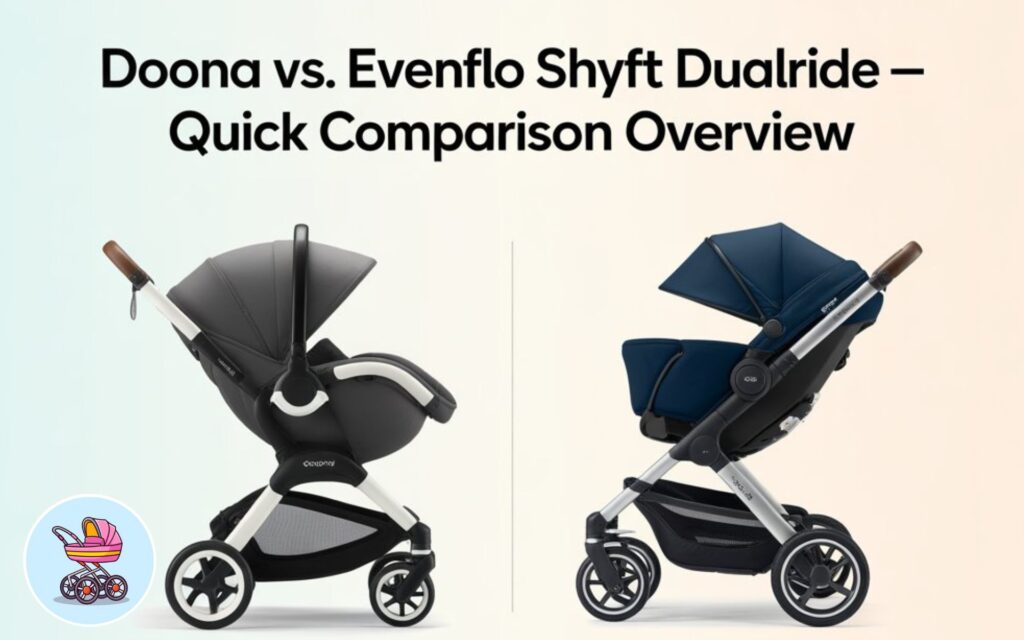
Strip away the marketing, and here’s what you’re actually choosing between.
Both products click into your car as a rear-facing infant seat, then unfold into a stroller with one motion — no base to remove, no separate frame to buy. That’s where the similarities end.
The Doona holds babies from 4–35 lbs and weighs about 16.5 lbs as a complete unit. The Evenflo Shyft DualRide fits babies from 3–30 lbs, weighs roughly 20 lbs fully assembled, but drops to just 8 lbs when you detach the carrier from the wheeled base — a feature the Doona doesn’t offer, since its wheels are permanently attached. Both top out at a 32-inch height limit, so expect to size up to a convertible car seat somewhere between 12–18 months.
If you’re bringing a smaller newborn home from the hospital, the Evenflo’s 3 lb minimum gives you a bit more room than the Doona’s 4 lb floor.
| Feature | Doona | Evenflo Shyft DualRide |
|---|---|---|
| Weight Range | 4–35 lbs | 3–30 lbs |
| Height Limit | 32 in | 32 in |
| Product Weight | ~16.5 lbs | ~20 lbs (8 lbs carrier only) |
| Fold Mechanism | 1-button | 2-button |
| Wheels | Permanently attached | Detachable |
| Harness | Rethread | No-rethread (8 positions) |
| Safety Tech | 3-layer side impact | SensorSafe (Bluetooth) |
| Storage Basket | None | Optional carryall bag |
| FAA Approved | Yes | Yes |
| Starting Price | ~$650 | Lower base price |
Design & Build Quality — Which Car Seat Stroller Is Better Built?
Pick either one up and you’ll immediately feel the design philosophy behind it.
The Doona folds inward into one compact, self-contained unit. Nothing detaches, nothing gets left behind at home — you fold it, you carry it, you’re done. That simplicity is exactly why it became the go-to pick for parents who fly or take rideshares constantly.
The Shyft DualRide takes the opposite approach. Its chassis separates from the wheels, so you can leave the heavy base and wheels in the car and carry just the 8 lb carrier inside — useful if you’re headed somewhere with stairs or a crowded waiting room. Evenflo also includes wheel wells that shield your vehicle’s upholstery from dirt and debris, a small detail that saves your back seat from scuff marks over a year of daily use.
Safety Standards & Crash Test Performance
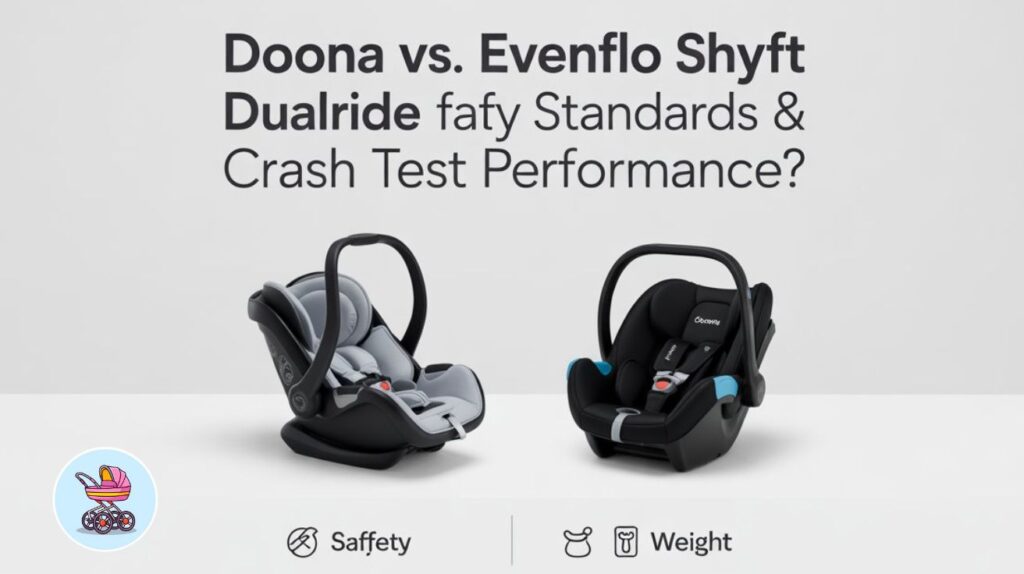
Safety is the one place you don’t want to compromise, and both seats clear that bar in different ways.
Both meet U.S. federal crash safety standards (FMVSS 213) and include anti-rebound protection — the Doona uses an anti-rebound bar built into the seat, while the Evenflo relies on an anti-rebound base. Both approaches limit how far the seat can move in a frontal impact.
Where they split is technology. The Shyft DualRide’s SensorSafe chest clip pairs over Bluetooth with a phone app and sends a real-time alert if the harness comes unbuckled or the car gets too hot — genuinely useful if you’re the parent who double-checks the clip from the rearview mirror. The Doona skips the electronics entirely and leans on its three-layer side-impact structure and memory foam lining instead. Neither is objectively “safer” — one just adds a tech layer on top of the same baseline protection.
Ease of Use — Installation, Folding & Everyday Convenience
Ease of use is what you’ll actually notice at 7am with a screaming toddler and a rideshare waiting outside.
The Doona converts with one button — the same button folds it down and pops it back into a stroller. That’s it. No second step, no repositioning. It’s why it’s become the default pick for parents jumping in and out of Ubers and taxis all day.
The Evenflo needs two buttons — one to fold the wheels down, a separate one to unfold them — which takes a few extra tries to get muscle memory for. In exchange, its QuickConnectors and belt-tensioning base give you a genuinely fast, snug vehicle install, and you can run it wheels-only without the base if you’re moving between cars often.
Comfort for Baby & Parents
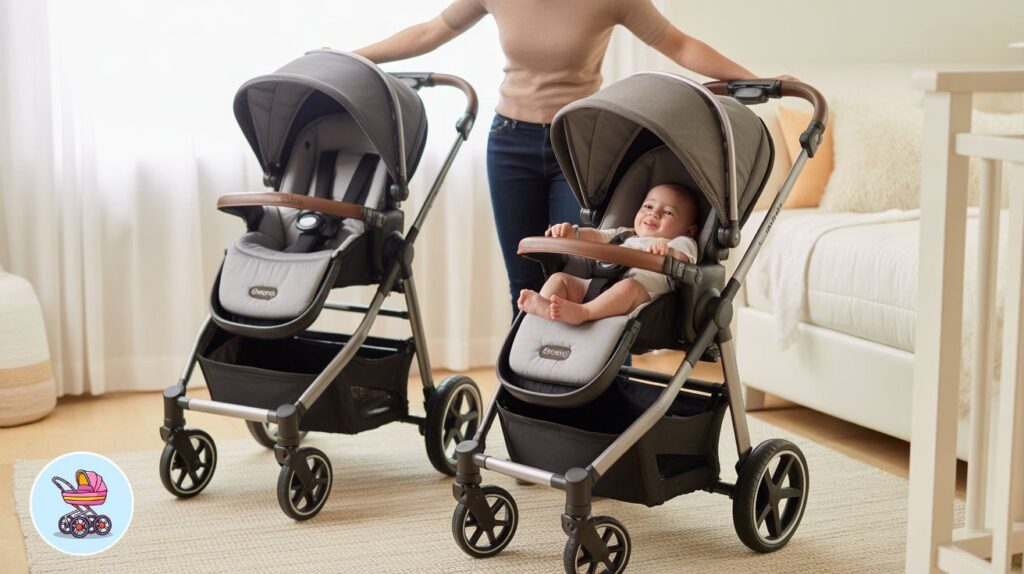
Comfort isn’t just about the baby — it’s about how many times you have to stop and re-adjust something mid-walk.
The Doona uses a rethread harness, so as your baby grows you’ll need to unthread and rethread the straps through a higher slot — a five-minute job, but an annoying one to do curbside. The Shyft DualRide uses a no-rethread harness with 8 height positions, so you just squeeze a lever at the headrest and slide it up. It’s a small difference that adds up over a year of growth spurts, and taller parents also get a slightly higher handlebar on the Evenflo, which is easier on your back during long walks.
Sun Protection & Newborn Fit — Canopy, Insert & Recline
This is the part most comparisons skip, and it matters the first time you’re stuck at a bus stop in direct sun with a two-week-old.
Both seats come with a canopy rated UPF 50+, so sun exposure isn’t a dealbreaker either way. The difference is coverage: the Evenflo Shyft DualRide’s higher-tier trims add an extended canopy that pulls forward further, giving more shade during midday walks. The Doona’s canopy is smaller and built more for quick trips than long stroller sessions.
For newborns, both brands include an infant insert designed to cradle a smaller baby (roughly 3–6 lbs) in a near-flat, supported position until they’ve grown into the harness properly. Neither seat reclines flat in car seat mode — that’s normal for rear-facing infant seats — but as a stroller, the Doona’s newer Doona X model adds three recline positions (Sit, Relax, Lean Back), something the standard Shyft DualRide doesn’t offer. If a fully reclining stroller ride matters to you, that’s worth checking before you buy either base model.
Size, Weight & Car Compatibility (Including Small Cars & 3-Across)
If you drive a compact sedan, this section matters more than any feature list.
The Doona is the more space-efficient pick — its folded footprint takes up less front-to-back depth, which helps if you’re trying to fit it behind a front seat in a smaller car. The Shyft DualRide folds down to roughly 17.9″ x 21.9″ x 24.8″, slightly bulkier, but its detachable 8 lb carrier means you’re not always lifting the full 20 lb unit out of a tight back seat — just the seat itself.
If you’re planning a 3-across setup with two other car seats, measure your back seat width before buying either one; both are wider than a standard infant seat once the stroller wheels are factored in.
Doona vs Evenflo Shyft — Travel & Urban Lifestyle Comparison
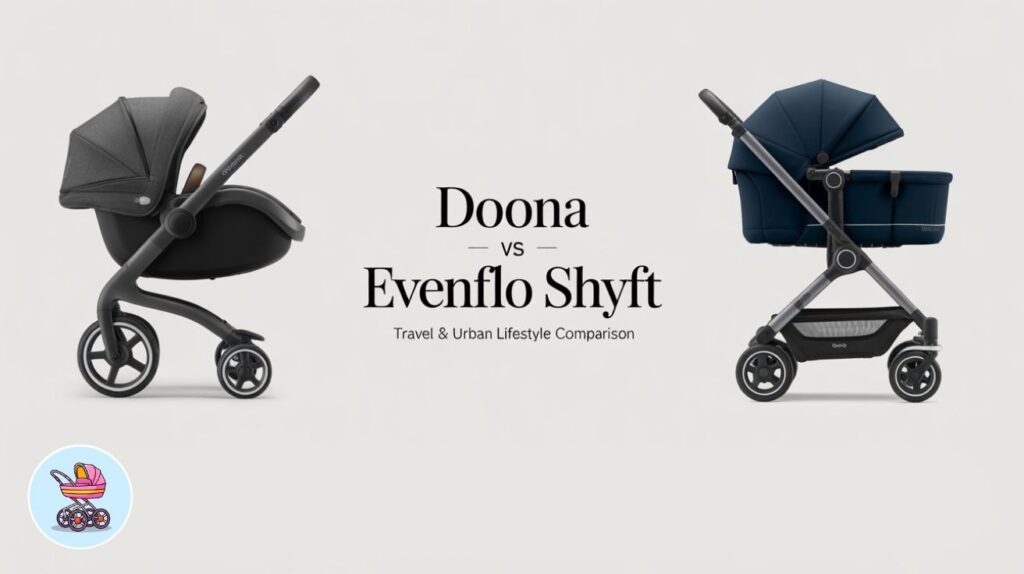
Where you actually live changes which of these makes sense.
If your daily routine is car-to-curb-to-elevator — rideshares, flights, quick errands — the Doona’s one-piece design shines. Both car seats are FAA-approved for airplane use, but the Doona’s lack of a detachable frame means one less thing to lose track of in an airport line.
If your days involve longer stroller walks, grocery runs, or park trips, the Shyft DualRide’s more traditional stroller feel and larger wheels handle those stretches more comfortably than the Doona’s smaller, city-built wheels.
Price, Value for Money & Long-Term Use
Here’s where the real trade-off shows up: price.
The Doona + starts around $650, with the newer Doona X running closer to $850 — no base, no accessories, that’s the complete unit out of the box. The Evenflo Shyft DualRide’s base model typically lists lower, with mid-tier trims adding a carryall storage bag (something the Doona doesn’t offer at all) and an extended canopy for more upfront cost. Evenflo also offers “Green & Gentle” fabric options that are flame-retardant-free, which some parents specifically look for.
Prices shift often on both, so check current listings before you decide — that’s what the Amazon links throughout this page are there for.
Pros & Cons — Doona vs. Evenflo Shyft DualRide
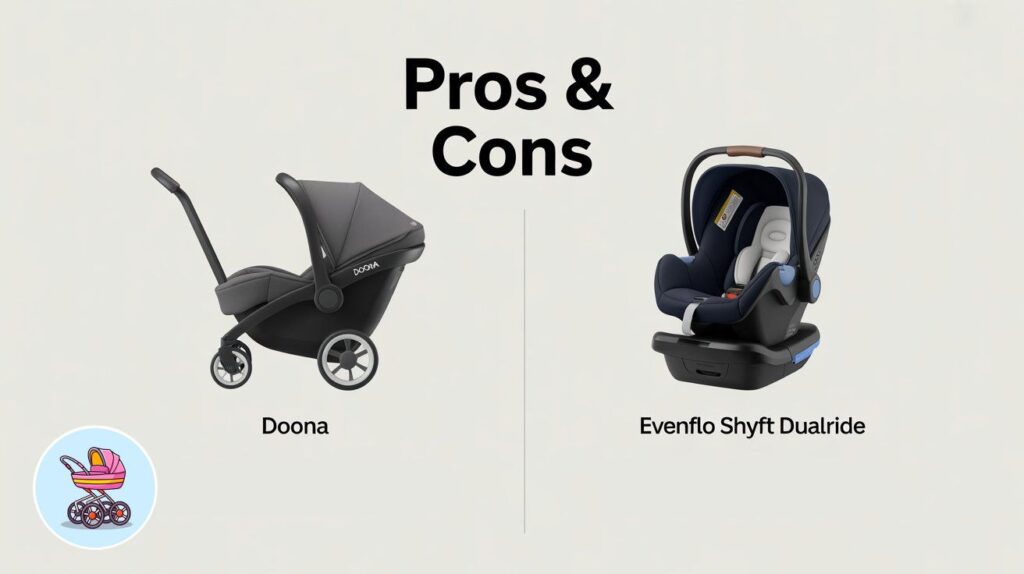
Doona — Pros & Cons
Pros:
- One-button fold from car seat to stroller, no relearning required
- No base needed for travel — the whole unit works standalone
- Lighter overall (16.5 lbs) and more compact folded footprint
Cons:
- Rethread harness makes growth adjustments slower
- No storage basket or carryall option
- Wheels can’t detach, so you’re always carrying the full unit
Evenflo Shyft DualRide — Pros & Cons
Pros:
- Carrier detaches to just 8 lbs when you don’t need the wheels
- No-rethread harness with 8 height positions
- SensorSafe Bluetooth chest-clip alerts and optional carryall storage
Cons:
- Two-button fold/unfold takes more practice than the Doona
- Bulkier folded size, less ideal for tight trunks
- Fully assembled weight (~20 lbs) is heavier to lift as one piece
Final Verdict — Which Car Seat Stroller Combo Should You Buy?
There’s no universal winner here — just a better fit for how you actually move through your day.
Choose the Doona if your life runs on rideshares, flights, and quick in-and-out trips where speed and a single-piece design matter more than storage or adjustability.
Choose the Evenflo Shyft DualRide if you want a detachable carrier for stairs and tight spaces, an easier-to-adjust harness as your baby grows, and don’t mind a slightly bulkier stroller in exchange for more flexibility.
Still deciding? Compare more options in our Evenflo vs Doona guide, or check our full Infant Car Seats roundup.
FAQs
1. How long can you use the Evenflo Shyft DualRide?
You can use the Evenflo Shyft DualRide until your child reaches the 32-inch height limit or about 30 lbs, which is typically around 12–18 months depending on your baby’s growth.
2. Is Doona or Evenflo Shyft better?
If you want the simplest car seat stroller combo for travel and quick trips, the Doona is easier to use, but the Evenflo Shyft DualRide offers more features and adjustability for daily use.
3. Is Evenflo Shyft DualRide Airlines approved?
Yes, the Evenflo Shyft DualRide is FAA-approved for airplane travel when used in the appropriate seat, making it a good airplane travel car seat stroller.
4. Is the Evenflo Shyft DualRide safe?
Yes, the Evenflo Shyft DualRide meets U.S. safety standards and includes safety features like the SensorSafe chest clip to help protect your child.
5. What are the pros and cons of Evenflo Shyft?
The Evenflo Shyft DualRide offers easy harness adjustment and flexible use, but it can take more space in your car and is a bit heavier than simpler models.
6. What is the Evenflo car seat controversy?
Evenflo has faced recalls and lawsuits tied to older models over the years, mostly involving harness and booster seat safety concerns. As of this writing, the current Shyft DualRide hasn’t been part of those specific issues, but it’s always worth checking Evenflo’s official recall page before buying secondhand or from an unofficial seller.
7. Is the Doona FAA-approved for flights too?
Yes. Like the Evenflo Shyft DualRide, the Doona is also FAA-approved for airplane use, making both solid choices for parents who travel by air often.
8. Which is cheaper, Doona or Evenflo Shyft DualRide?
The Evenflo Shyft DualRide’s base model typically costs less upfront than the Doona +, though prices shift often on both — check current listings before deciding.
9. Can you remove the wheels from the Evenflo Shyft DualRide?
Yes. Unlike the Doona, whose wheels stay permanently attached, the Shyft DualRide’s carrier detaches from its wheeled base, dropping to about 8 lbs when carried on its own.
Written by Saim Mughal, founder of Care for Cuties. A parent who tests strollers and car seats firsthand, Saim built this site to give other parents honest, detail-level comparisons — backed by official specs, not just brand copy.