Baby Hair Color Predictor
Select hair colors for parents and grandparents to predict your baby's hair color
Predicted Baby Hair Color
Baby Hair Color Calculator — Try It Free
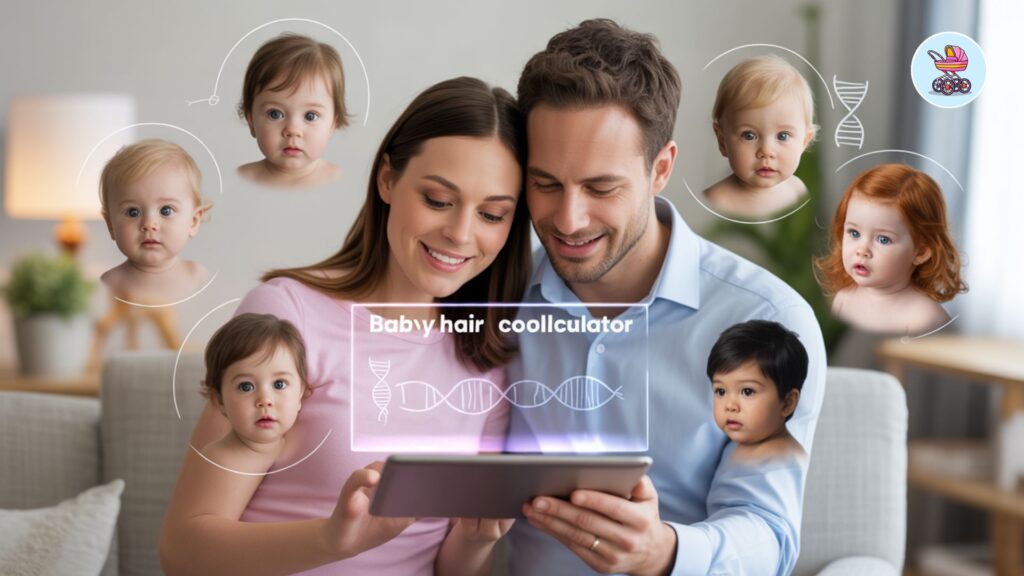
Just select mom’s hair color, dad’s hair color, and optionally add grandparents’ colors. Hit calculate — and see your baby’s most likely hair color in seconds.
Want to take it one step further? Try our baby eye color calculator too — it works the same way and is just as fun!
You are 28 weeks pregnant. The nursery is painted. The name is picked. And every single day, someone asks you the same question: “What do you think the baby will look like?”
Hair color is always at the top of that list. You look at your hair, you look at your partner’s hair, and you wonder — will she have your dark waves? His sandy blonde? Or will genetics throw a total curveball?
Our baby hair color calculator takes the guesswork out of it. Enter a few details, get a real genetic prediction — and have a lot of fun along the way.
Table of Contents
How Does a Baby Hair Color Calculator Work?
The calculator is not magic — it is science made simple. It uses the same basic rules of genetics that biologists have studied for over 150 years.
Each parent passes down genetic instructions called alleles. These alleles tell your baby’s body how much pigment to produce — and that pigment is what creates hair color. The calculator looks at both parents’ hair colors (and grandparents, if you add them) and estimates the most likely outcome.
What Genes Decide Your Baby’s Hair Color?
Hair color comes down to one thing: melanin. Melanin is the pigment that colors your hair, skin, and eyes.
There are two types that matter most:
- Eumelanin — creates black and brown tones. More eumelanin = darker hair.
- Pheomelanin — creates red and yellow tones. More pheomelanin = red or strawberry blonde hair.
Blonde hair has very low levels of both. Black hair has very high eumelanin. Red hair has a unique mix — driven largely by a gene called MC1R (more on that below).
Scientists have found that up to 21 different genes influence hair color. No single gene is fully in charge — they all work together. That is why hair color prediction is an estimate, not a guarantee.
Hair Color Dominance — Quick Reference Table
| Parent Hair Colors | Most Likely Baby Hair | Can a Surprise Happen? |
| Brown + Brown | Brown | Yes — blonde is rare but possible |
| Blonde + Blonde | Blonde | Yes — brown can appear |
| Dark Brown + Blonde | Dark Brown | Yes |
| Red + Brown | Auburn or Brown | Yes |
| Black + Any Color | Dark | Yes |
What Color Hair Will My Baby Have? Common Parent Combinations
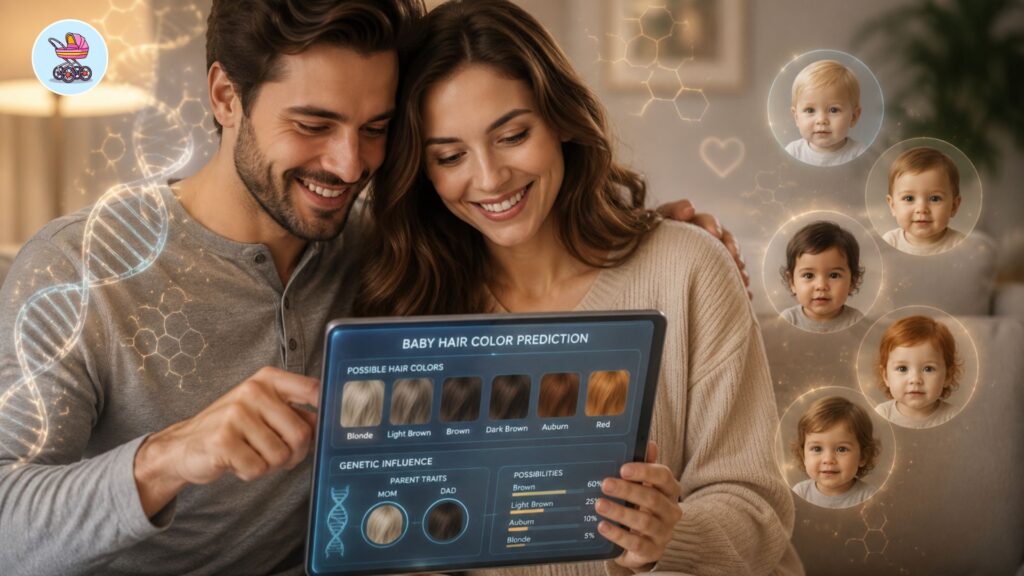
Here is where it gets really fun — and sometimes really surprising.
Real parent moment: “My husband has jet-black hair and I’m a natural blonde. Everyone told us the baby would definitely have dark hair. She came out with light brown hair that turned into the most gorgeous auburn by age two. The calculator actually predicted auburn as a possibility — I was shocked!” — Madison, Ohio
Two Brown-Haired Parents
Brown hair is a dominant trait. If both you and your partner have brown hair, your baby will most likely have brown hair too.
But here is the twist — if either of you secretly carries a recessive blonde gene, there is a small chance your baby could come out with lighter hair. Genetics loves a surprise.
One Blonde + One Brunette Parent
In this combination, dark hair usually wins. Brown is dominant over blonde in most cases.
Your baby will most likely have brown or dark blonde hair. But do not rule out a lighter shade — especially if grandparents on either side were blonde.
Can Two Blonde Parents Have a Dark-Haired Baby?
This is one of the most common questions parents ask — and the answer is: yes, but it is rare.
Blonde hair is a recessive trait. Two blonde parents almost always produce a blonde baby. However, if one parent carries a hidden gene variation (like the KITLG gene variant), a darker shade is possible. It does not happen often, but genetics is never 100% predictable.
Red Hair — The Wildcard of Baby Hair Genetics
Red hair plays by completely different rules. It is caused by specific variants of the MC1R gene, and it works through what scientists call incomplete dominance — meaning it blends rather than fully takes over.
- Red allele + Blonde allele = Strawberry blonde
- Red allele + Brown allele = Auburn
- Two red alleles = True redhead
True redheads are incredibly rare. Only 1–2% of the world’s population has naturally red hair. If your baby is a redhead — celebrate that, because it is genuinely special.
Will My Baby’s Hair Color Change After Birth?
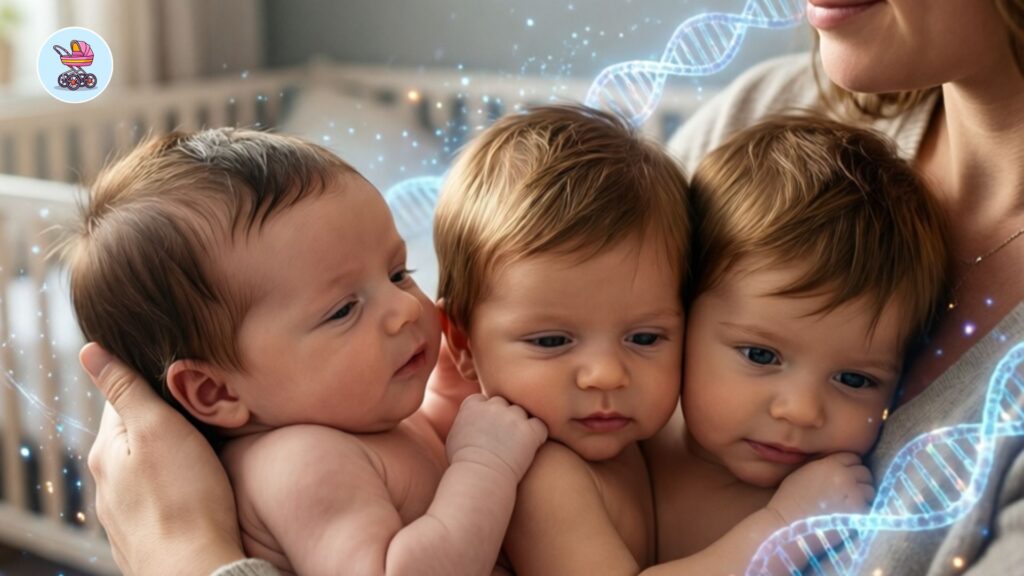
Yes — and this surprises a LOT of new parents.
Many babies are born with hair that looks very different from what they end up with at age three. Melanin production increases as your baby grows. A baby born with light wispy hair can easily develop dark, thick hair by toddlerhood.
Sun exposure, hormonal changes, and genetics all play a role in how hair color shifts in the first few years.
Baby Hair Color Change Timeline
[ALT TEXT: “Timeline chart showing how baby hair color changes from birth to age three”]
| Baby’s Age | What You Might Notice |
| At Birth | Hair is often lighter than the final color will be |
| 3–6 Months | True color begins to show through |
| 12–18 Months | Hair thickens and color becomes more stable |
| 2–3 Years | Color is usually close to what it will be long-term |
So when you use the baby hair color calculator, think of it as predicting your toddler’s hair — not necessarily the color you will see in the delivery room.
How Accurate Is a Baby Hair Color Calculator?
Let’s be honest here — because most sites skip this part.
A baby hair color calculator gives you a probability, not a certainty. Human hair color involves 21+ genes. Online calculators simplify this down to the most important ones to give you a realistic estimate.
Think of it like a weather forecast. An 80% chance of rain does not mean it will definitely rain — but it is still useful information. The same goes for hair color predictions.
The more information you enter (especially grandparents’ hair colors), the more accurate the estimate becomes. But genetics can always surprise you — and that is honestly one of the most wonderful things about having a baby.
Use it as a fun tool. Enjoy the guess. And then be delighted by whatever your little one actually arrives with.
Use the Baby Hair Color Calculator as a Baby Shower Game

Here is a fun idea that no one talks about — and it works beautifully.
Turn the hair color calculator into a baby shower game!
Here is how:
- Print a simple sheet showing mom and dad’s hair colors
- Ask each guest to write down their prediction for baby’s hair color
- Run the calculator together at the shower and reveal the genetic prediction
- Whoever guessed closest wins a small prize
It is low-cost, interactive, and gets everyone laughing. Looking for more ideas like this? Check out these fun coed baby shower games that work great for mixed groups.
And if you want a full list of crowd-pleasing options, these are the baby shower games your guests will love — tried, tested, and actually fun.
Frequently Asked Questions About Baby Hair Color
1. How does a baby hair color calculator work?
It uses basic genetic principles — dominant and recessive alleles — to estimate which hair color your baby is most likely to inherit. You enter mom and dad’s hair colors (and optionally grandparents’), and the tool calculates the most probable outcome. It gives probabilities, not guarantees.
2. Can two blonde parents have a brunette baby?
It is rare, but yes. Blonde is a recessive trait, so two blonde parents usually produce a blonde baby. However, a gene variant like KITLG can occasionally result in darker hair.
3. What is the rarest baby hair color?
True red hair is the rarest — only about 1–2% of people worldwide are natural redheads. It requires specific MC1R gene variants from both parents.
4. Does my baby’s hair color come from mom or dad?
Both equally. Each parent passes down one allele per gene. Neither mom nor dad has more influence — it depends on which alleles are dominant and how they combine.
5. Will my baby’s hair color change after birth?
Yes, very likely. Many newborns have lighter hair than their final color. Melanin production increases as babies grow, so hair often darkens in the first 2–3 years.
6. How accurate is a baby hair color predictor?
It is a solid estimate — not a certainty. The more inputs you add (especially grandparents), the more refined the prediction. Think of it like a weather forecast: useful and often right, but not guaranteed.
7. Can two dark-haired parents have a red-haired baby?
Yes — if both parents carry a recessive MC1R gene variant, their baby can have red hair even if neither parent does. It is uncommon, but it happens.
8. What gene controls red hair in babies?
The MC1R gene is the primary driver of red hair. Specific variants of this gene cause the body to produce more pheomelanin (red/yellow pigment) instead of eumelanin (brown/black pigment).
Try the Baby Hair Color Calculator Above — Then Plan the Reveal!

The baby hair color calculator at the top of this page is free and takes less than a minute. Enter your colors, see the prediction, and share it with your family.
Planning a shower? Pair this with the best baby shower themes for 2026 to make the whole event feel extra special. Or add a hair color guessing round to your game lineup with this baby animal baby shower game — guests go wild for it.
Whatever color hair your baby arrives with — it is going to be absolutely perfect.
— Saim Mughal, Founder, CareForCuties.com
Sources: FamilyEducation.com — Hair Color Genetics; World Population Review — Global Hair Color Distribution; The Tech Interactive — Hair Color Prediction (2025)