Baby Eye Colour Calculator
Predict your baby’s possible eye color based on parents’ and grandparents’ eye colors.
Baby Eye Color Calculator 2026: Predict What Color Eyes Your Baby Will Have
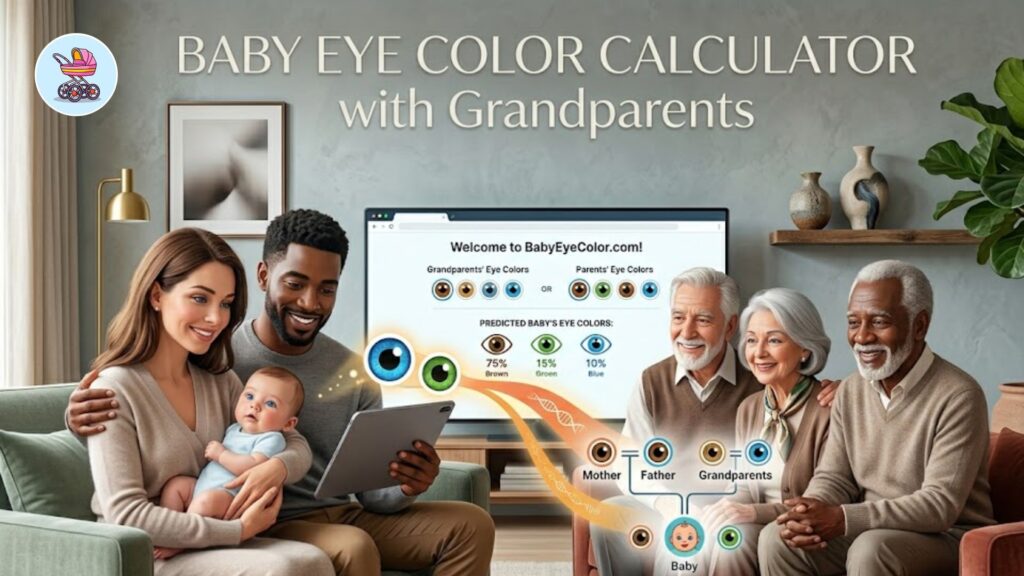
You’ve been staring at your own eyes — then your partner’s — and wondering: what color will our baby’s eyes be? The old paper charts are confusing. Most online tools spit out a number with zero explanation.
Here’s the good news. Our baby eye color calculator does the hard work for you. And this guide explains exactly what those results mean — in plain, honest parent language.
Table of Contents
What Is a Baby Eye Color Calculator?
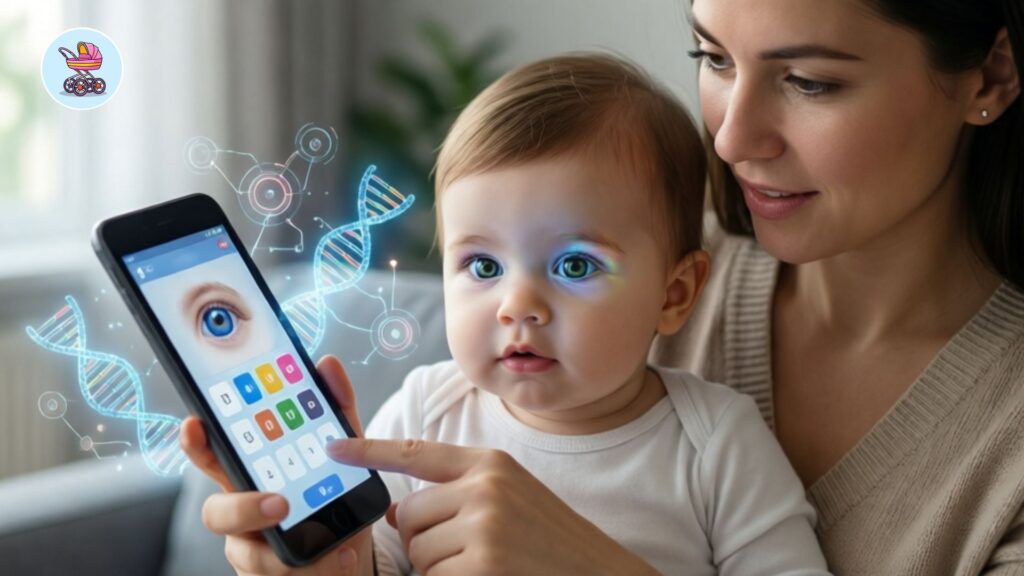
A baby eye color calculator is an online tool that predicts the likely eye color of your baby based on genetics. You enter the eye colors of both parents — and some tools let you add grandparent colors too — and the tool gives you probability percentages for each possible color.
Think of it as a probability tool, not a crystal ball. It uses established genetic patterns to estimate outcomes. It cannot see the actual genes each parent carries — only DNA testing can do that.
Still, for curious parents, it’s one of the most fun parts of expecting. You get real, science-backed estimates based on what we know about how eye color is inherited.
Getting ready for your newborn? Our guide to the best infant car seats for newborns is a great next step once you’ve satisfied your eye color curiosity.
How Does Eye Color Genetics Actually Work?
Dominant vs. Recessive Genes — Explained Simply
Eye color is passed down through genes — one copy from Mom and one from Dad. Some genes are dominant (they “win” over others) and some are recessive (they hide unless paired with another recessive gene).
Brown eyes are generally dominant. Blue eyes are generally recessive. That means:
- A brown-eyed parent can carry a hidden recessive blue gene
- If both parents pass on their recessive blue genes, the baby can have blue eyes — even if both parents have brown eyes
- The odds of that happening? About 6–7% when both parents have brown eyes
🗣️ A Common Scenario: Two brown-eyed parents who both unknowingly carry a recessive blue-eye gene end up with a blue-eyed baby. This isn’t rare luck — it’s basic recessive inheritance. If you’re in this situation, the calculator’s 6–7% figure is exactly what you’re seeing play out.
Why Eye Color Is More Complex Than You Think
Here’s what most articles don’t tell you: eye color is a polygenic trait. That means it’s not controlled by just one gene — it’s influenced by 16 or more genes working together.
Two genes do most of the work: OCA2 and HERC2. These control how much melanin (pigment) your baby’s eyes produce. More melanin = darker eyes. Less melanin = lighter eyes.
Because so many genes are involved — and because eye color genes interact with each other in ways scientists are still mapping — exact prediction is impossible. Even researchers who study OCA2 and HERC2 directly can only estimate probabilities, not certainties. The calculator gives you the most likely outcome, not a guarantee.
According to NIH MedlinePlus, eye color genetics involves multiple genes working together rather than a single simple inheritance pattern.
What’s Actually Happening in the Genes (The Punnett Square Explanation)
Here’s the part calculators don’t show you on the results screen.
Every parent carries two copies of each eye-color gene — one they show, one they might be hiding. A brown-eyed parent could be “BB” (two brown copies) or “Bb” (one brown, one blue, with brown winning out visibly).
If you’re “Bb” and your partner is “Bb,” your baby has four possible combinations: BB, Bb, Bb, bb. Three of those four show brown eyes. One — the “bb” combination — shows blue. That’s where the 25% comes from in two-brown-eyed-parent pairings.
The catch: nobody can tell from looking at someone whether they’re “BB” or “Bb.” That’s why even a calculator that knows both parents’ eye colors is still working off probabilities, not certainties — it doesn’t know which hidden copy each parent is carrying unless you also know the grandparents’ eye colors.
Baby Eye Color Probability Chart — By Parent Combination
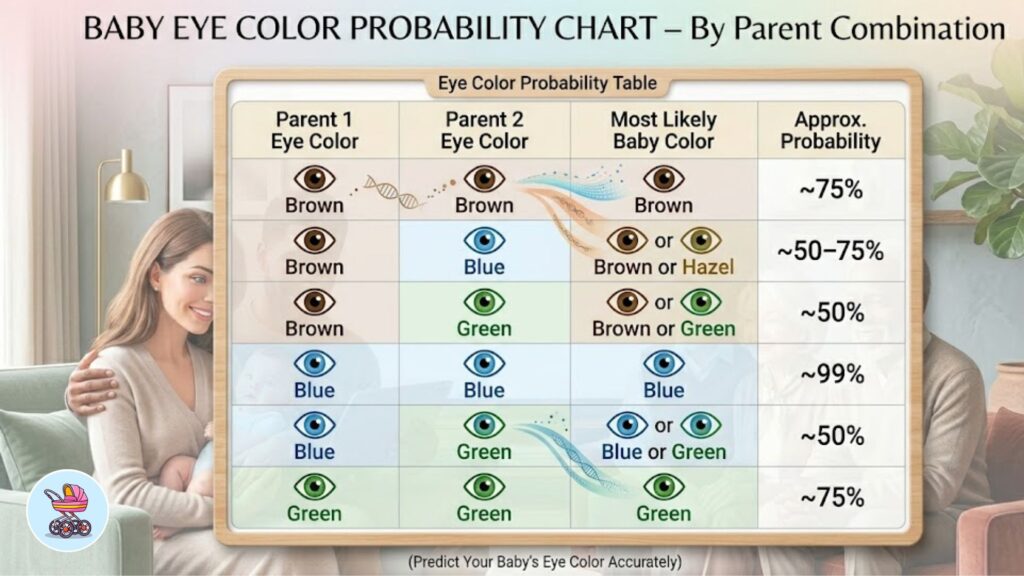
Eye Color Probability Table
| Parent 1 Eye Color | Parent 2 Eye Color | Most Likely Baby Color | Approx. Probability |
|---|---|---|---|
| Brown | Brown | Brown | ~75% |
| Brown | Blue | Brown or Hazel | ~50–75% |
| Brown | Green | Brown or Green | ~50% |
| Blue | Blue | Blue | ~99% |
| Blue | Green | Blue or Green | ~50% |
| Green | Green | Green | ~75% |
Note: Probabilities are approximate and based on simplified genetic models. Real genetics can surprise you — and that’s part of what makes every baby unique.
When Does Baby Eye Color Stop Changing?
The Melanin Timeline Every Parent Should Know
Here’s something most articles get wrong — or just skip entirely. Most say eye color settles at “6 to 12 months.” That’s only part of the story.
Eye color can keep shifting until age 3. Some children see smaller changes even after that. Here’s why:
- Babies are born with little to no melanin in their irises — this is why many babies, especially those of European descent, start out with blue or gray eyes
- After birth, melanocytes (melanin-producing cells) slowly activate
- As melanin builds up, eye color darkens — gray can become blue, blue can turn green or hazel, and hazel can deepen to brown
- This process usually peaks around 6–12 months but can continue through the toddler years
🗣️ Real Parent Moment: “My daughter was born with stunning gray-blue eyes. At 8 months they started turning green — by her second birthday they were hazel. I had no idea that was even possible. Our calculator had predicted green at 30%, so in hindsight, it wasn’t wrong!”
The key takeaway: if your newborn’s eye color doesn’t match the calculator’s top prediction yet, wait. The final color may still be coming.
[EXTERNAL LINK: American Academy of Pediatrics (AAP) — Newborn appearance ]
Rare Eye Colors — What Are the Odds Your Baby Has Them?

Most people know brown, blue, and green. But eye color has a wider range than most parents realize. Here’s a quick breakdown of how rare each color really is.
Rare Eye Color Stats at a Glance
| Eye Color | % of World Population | Key Notes |
|---|---|---|
| Brown | 55–79% | Most common globally; dominant gene |
| Blue | 8–10% | More common in Northern European ancestry |
| Hazel | ~5% | Mix of brown and green tones |
| Green | ~2% | Rarest of the “common” colors |
| Gray | <1% | Often mistaken for light blue |
| Amber | <1% | Golden or coppery tone; very uncommon |
Heterochromia — where a person has two different colored eyes — affects less than 1% of the population. It can be genetic or caused by other factors. Most calculators don’t predict it, since it involves very specific gene expression patterns.
Can Mixed-Race Parents Predict Their Baby’s Eye Color?
This is a question almost no other article addresses — and it’s one of the most common searches from US parents today.
The short answer: mixed-race genetics add complexity. Here’s what to know:
- Higher melanin ancestry (South Asian, African, Latino, Middle Eastern backgrounds) means a higher likelihood of brown eyes — because the brown gene is dominant
- When one parent carries high-melanin genetics and the other has low-melanin eye colors (blue, green), brown or dark hazel is the most probable outcome
- Standard calculator tools have limitations here — they’re built on simplified models, not complex multi-ethnic gene interactions
- For more accurate predictions, DNA testing from services like 23andMe or AncestryDNA provides detailed pigmentation data
🗣️ Real Parent Moment: “My husband is South Asian with deep brown eyes. I have green eyes. The calculator predicted 85% brown — and sure enough, our son has the most beautiful deep brown eyes. But our daughter surprised us with hazel. That 15% chance showed up!”
Use the calculator as a fun starting point. For mixed-race families, treat it as one data point — not a definitive prediction.
How Accurate Is the Baby Eye Color Calculator?
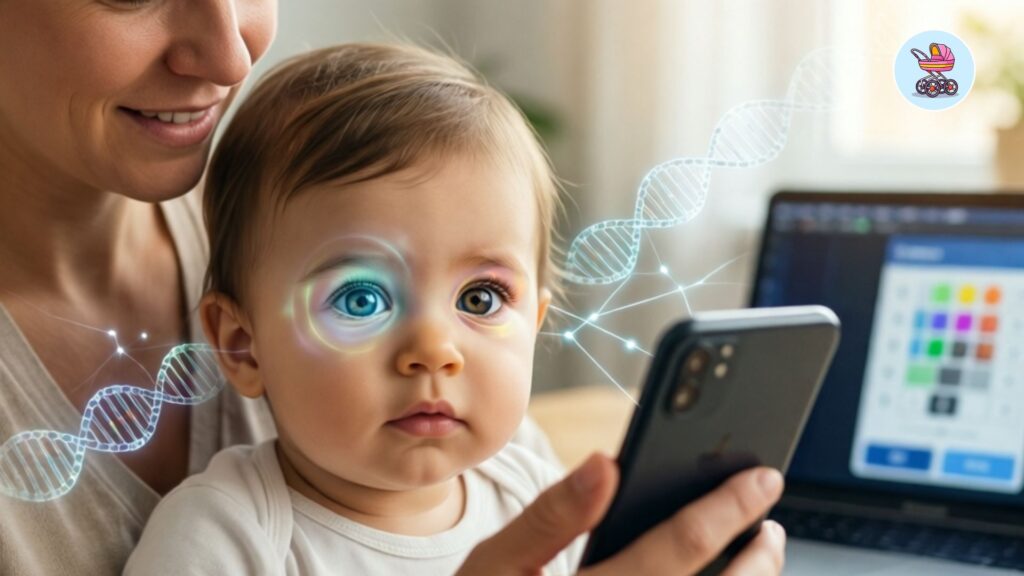
Accuracy is the question every parent asks — and deserves an honest answer.
A standard baby eye color calculator that uses only parents’ eye colors runs at roughly 60–75% accuracy for the most likely outcome. Adding grandparent data improves accuracy slightly, since it helps surface recessive genes that might otherwise stay hidden in the parents’ own eye color. The exact improvement varies by family — there’s no single agreed-upon percentage in the genetics literature, so treat any specific number (including ones you’ll see on other sites) as a rough estimate, not a verified statistic.
Calculator vs. DNA Testing — What’s the Difference?
| Method | Accuracy (Est.) | Cost |
|---|---|---|
| Baby Eye Color Calculator (parents only) | ~60–75% | Free |
| Calculator with Grandparent Input | ~65–80% | Free |
| DNA Testing (23andMe, AncestryDNA) | ~85–90% | $99–$199 |
The calculator is best for fun, bonding, and education. If you have a medical reason to need more precise genetic information, talk to your OB or a genetic counselor — not an online tool.
How to Use the Baby Eye Color Calculator on This Page
Using the tool above is simple. Here’s exactly what to do:
- Step 1: Select Mom’s eye color from the dropdown menu
- Step 2: Select Dad’s eye color from the dropdown menu
- Step 3 (Optional): Add grandparent eye colors for a more refined estimate
- Step 4: Hit “Calculate” — results appear as percentage probabilities for each color
- Step 5: The highest percentage = the most likely outcome. Lower percentages are still possible!
Remember — the results are estimates based on general genetic patterns. Enjoy the process. This is one of the genuinely fun parts of getting ready for your baby.
Speaking of getting ready — check out our picks for the best stroller for newborns to keep your planning on track.
What to Do After You Get Your Results

Got your prediction? Here’s how to make the most of it:
- Share with grandparents — they love being part of the prediction conversation
- Screenshot your results and compare once your baby arrives
- Remember: if your baby’s eyes don’t match at birth, wait. Color can shift for up to 3 years
- Don’t stress if the results surprise you — genetics is wonderfully unpredictable
- For rare conditions: if your family has a history of ocular albinism or other eye pigmentation conditions, speak with a pediatric ophthalmologist rather than relying on a calculator
Already thinking about baby gear? Our rotating car seat comparison guide helps you pick the safest, most convenient option for your growing family.
Frequently Asked Questions About Baby Eye Color
Q1: Can two blue-eyed parents have a brown-eyed baby?
Rarely, but yes. Eye color involves 16+ genes — not just one. Hidden genetic variants can occasionally produce unexpected results even when both parents have blue eyes. It’s uncommon, but not impossible.
Q2: When does baby eye color change permanently?
Most babies’ eye color settles between 6 and 12 months. However, changes can continue until age 3 — especially as melanin production gradually increases. Don’t assume the color you see at birth is the final one.
Q3: How accurate is a baby eye color calculator?
Most calculators offer roughly 60–75% accuracy using simplified genetic models. They’re a great fun and educational tool — not a medical prediction. For high accuracy, DNA testing is the only reliable option.
Q4: Do all babies have blue eyes at birth?
No. Babies with higher melanin ancestry — South Asian, African, Latino, or Middle Eastern backgrounds — are often born with brown or very dark eyes from day one. The “all babies have blue eyes” idea applies mainly to babies of Northern European descent.
Q5: What is the rarest baby eye color?
Green eyes affect only about 2% of the world’s population — making them the rarest of the “common” colors. Gray and amber are even rarer, each under 1%.
Q6: Can eye color skip a generation?
Yes. A grandparent’s recessive gene can skip a generation entirely and reappear in a grandchild. This is especially common with blue or green eyes. It’s one reason grandparent input can slightly improve calculator accuracy.
Q7: What determines a baby’s eye color?
Primarily the amount and distribution of melanin in the iris — controlled by 16+ genes, most notably OCA2 and HERC2, according to NIH genetics research. More melanin = darker eyes. Less melanin = lighter eyes.
Q8: Can mixed-race parents accurately predict their baby’s eye color?
Standard calculators are less reliable for mixed-race families because they use simplified models. Higher melanin ancestry strongly favors brown eyes. DNA testing provides far more accurate pigmentation data for families with diverse genetic backgrounds.
Where to Get More Help Planning for Your Baby
The baby eye color calculator is just one piece of the puzzle when you’re getting ready for a new arrival. There’s so much more to think about — and we’ve done the research to make it easier for you.
Start with the gear that keeps your baby safest from day one. Our guide to the best lightweight travel strollers covers the top options US parents trust in 2026. And if you’re looking at full systems, our baby strollers with car seats guide compares the most popular travel systems side by side.
You’ve got this, mama (and dad). Enjoy every exciting guess — including what color those little eyes will be.
— Saim Mughal, Founder of CareForCuties.com